

Public lecture: Embedded Sensing, a digital perception of the real world
On 24 September 2025, Bruno Rodrigues gave a public lecture, Embedded Sensing: Enabling a Digital Perception of the Real World, in the University of St. Gallen School of Computer Science Public Lecture Series.
What it covered. The talk built up embedded sensing from the ground up for a general audience: why invisible computers are already everywhere, how a sensor turns a physical quantity into a digital signal, and the ideas that decide how faithfully that digital copy matches reality, from sampling and the Nyquist-Shannon theorem to resolution, and then how systems act back on the world through actuators.
Why it matters. Almost everything around us now senses: a modern car alone carries dozens of sensors, and the same principles run from personal fitness trackers to life-critical aviation and industrial systems. Getting the accuracy, reliability, and privacy of that sensing right is what makes these systems trustworthy.
Your house as a perception layer for mental health
The final part of the talk turned to a question we find genuinely interesting. Mental health is a growing, and badly under-served, crisis: the World Health Organization counts hundreds of millions of people living with depression, one of the leading causes of disability worldwide, and notes that half of all lifetime mental-health conditions begin by age 18. Yet diagnosis remains hard, leaning on subjective, infrequent self-report, with real barriers to seeking help at all.
Meanwhile, the places we live are quietly filling up with sensors. Could the home itself act as a gentle, passive perception layer, noticing subtle changes in everyday behavior that may accompany a person’s mental state, without asking them to wear anything, charge anything, or keep a daily mood diary?
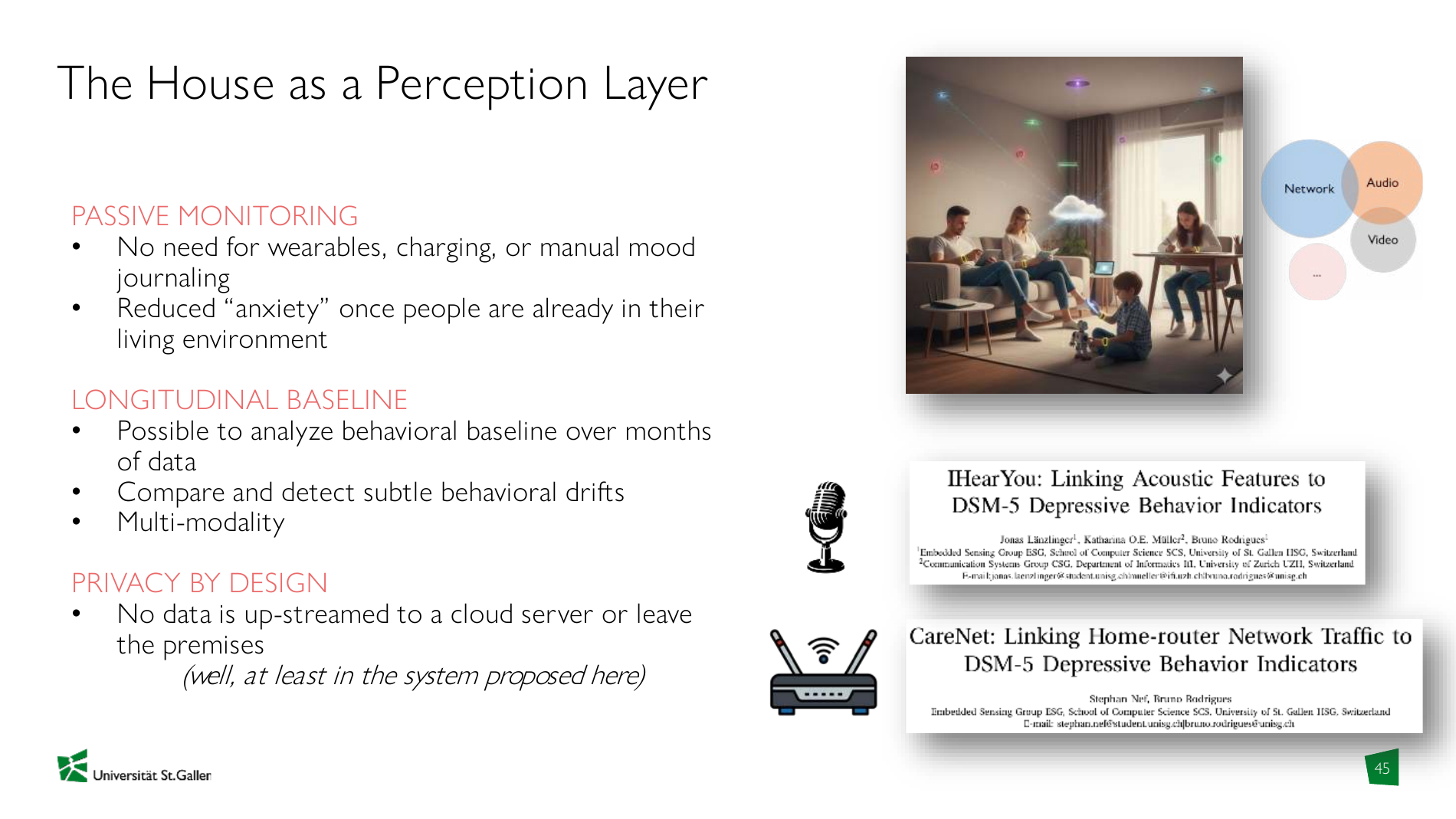
Because ambient sensing happens where people already are, it can build a longitudinal baseline over months and surface small drifts from a person’s own normal, rather than comparing them against a population average. The goal is not a verdict but awareness, an early, private nudge that something may be worth attention.
Two directions in our work illustrate the idea, both deliberately explainable rather than black-box, so a signal can be inspected and questioned:
- Speech. Acoustic and voice features carry information about affect; explainable rules link them to recognized behavioral indicators, all computed inside the home. This is the focus of Jonas Länzlinger’s thesis.
- Network. Even the traffic a household already produces has daily rhythms; Behavioral Observation Metrics translate those network features into the same indicators, as presented at IEEE/IFIP NOMS 2026 and detailed in Stephan Nef’s thesis.
Crucially, privacy is a first-class design goal: processing stays on the premises, and no raw audio or network traffic is streamed to a cloud. The aim is to support people and the clinicians who care for them, complementing professional diagnosis rather than replacing it, and never to surveil.
Copy & share
Edit if you like, then copy and paste into your post.