

Invited lecture on network security at HSG's Hacking Lab
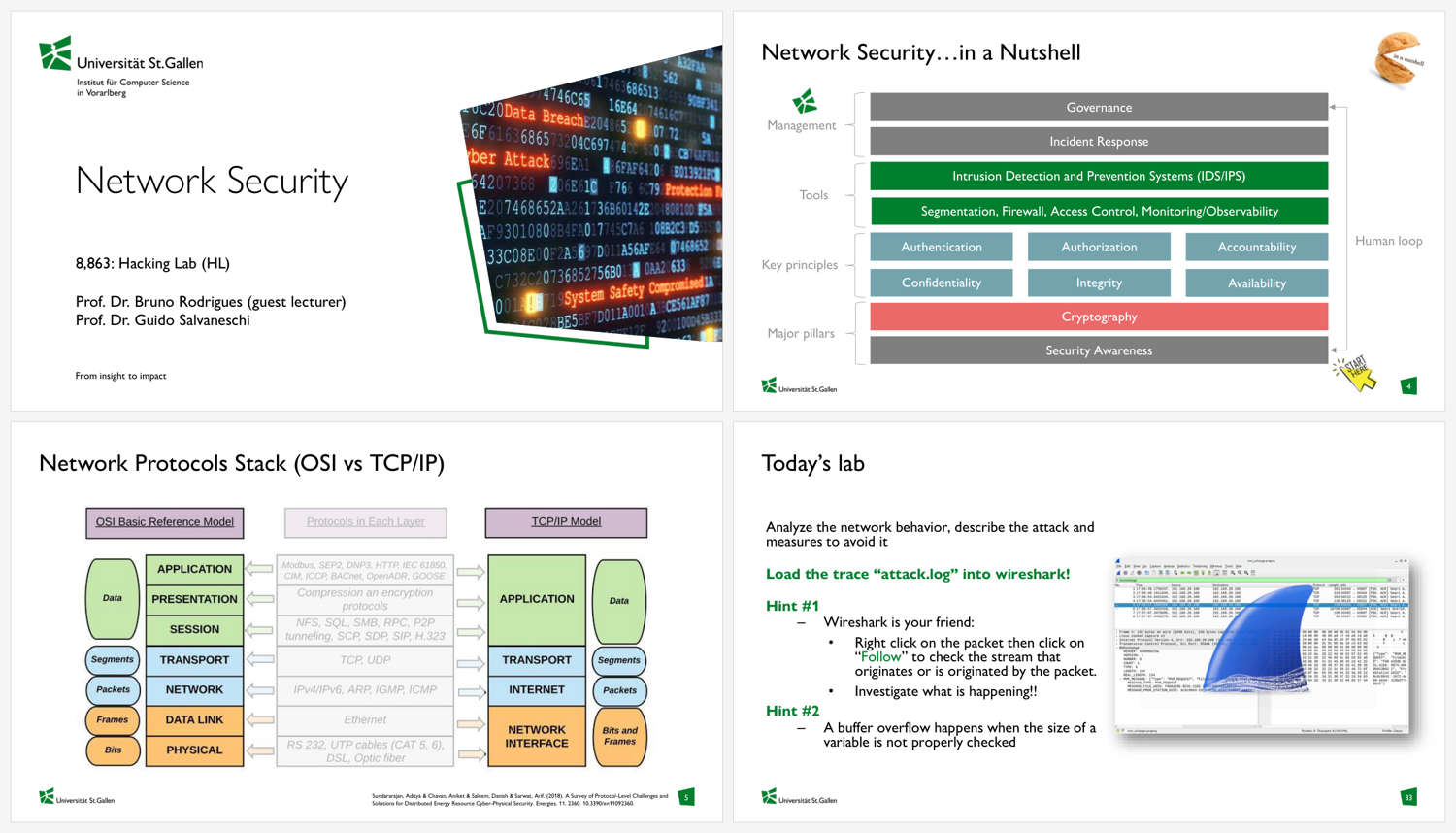
Bruno Rodrigues gave an invited lecture on network security in the Hacking Lab (8.863) at the University of St. Gallen, the hands-on security course run by our colleague Prof. Guido Salvaneschi and his Programming Group. The session ran as two blocks: 45 minutes of theory followed by 45 minutes of hands-on practice.
Theory (45 min). The first half covered the building blocks of network security: access-control models (DAC, MAC, RBAC, ABAC), network segmentation and firewalls (packet filtering and application-proxy/WAF designs), and intrusion detection and prevention systems (IDS/IPS), including signature-based vs anomaly-based and host-based vs network-based detection, and where monitoring and SIEM fit into the wider security landscape.
Practice (45 min). The second half moved to a real network capture in Wireshark: following TCP streams to reconstruct a session, spotting the attack in a provided trace, and reasoning through a buffer-overflow case and the measures that would prevent it.
Courses like the Hacking Lab are part of the young, fast-growing curriculum at HSG’s School of Computer Science, where students work close to real systems and current research. If you enjoy security and getting hands-on with networks, protocols, and attacks, and in strategic cybersecurity, this is exactly the kind of course you will find here: it feeds directly into the Strategic Cybersecurity specialisation of the Master in Computer Science, a direction we are actively building at HSG.
Thanks to Guido Salvaneschi for the invitation. The full slide deck is his course material and is not shared here; the images above are a short preview.
Copy & share
Edit if you like, then copy and paste into your post.