

OpenCSI accepted at IEEE LCN 2026
Karim Khamaisi’s paper OpenCSI: Self-Calibration Layer for Heterogeneous Mesh Wireless Sensor Networks was accepted as a full regular paper at the 51st IEEE Conference on Local Computer Networks (LCN 2026), one of the longest-running IEEE networking conferences, taking place on October 7 to 9, 2026 in Coimbra, Portugal. The paper also builds on contributions from Simon Sigg’s Bachelor’s thesis at HSG. Congratulations, Karim!
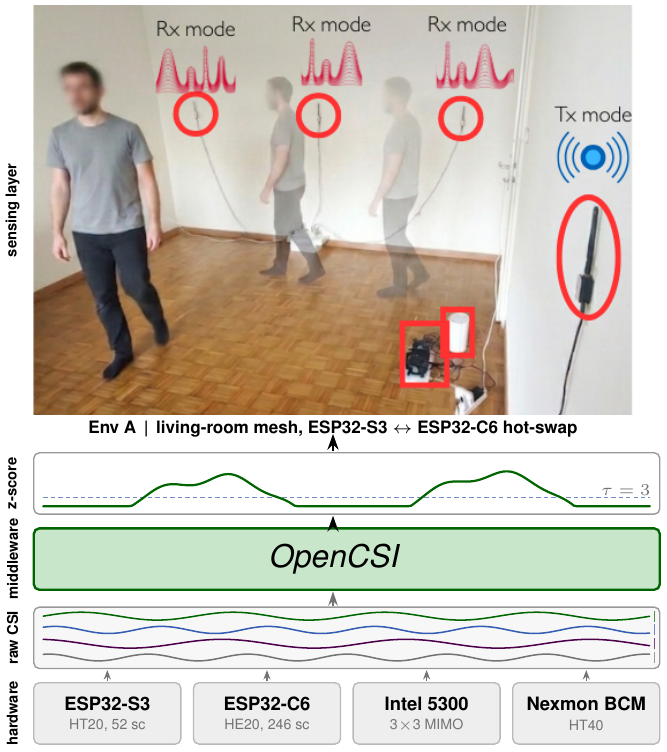
Abstract. WiFi CSI sensing models trained in one environment usually fail in another, because standard normalization embeds chip- and room-specific artifacts into the feature space. We propose OpenCSI, an abstraction layer that hides those artifacts from the sensing logic above by exposing each link as a dimensionless Z-score against its own quiet-period temporal standard deviation. The denominator is learned online from a 120-second empty-room bootstrap and reported with a maturity tag, so downstream code can detect drift and abstain when the baseline is unreliable.
We evaluate OpenCSI across three rooms and three ESP32 generations (S3, C3, C6 at HT20 and HE20), with two deployments varying chip and room together and one controlled S3↔C6 swap that holds positions fixed. A model trained on one cell holds binary F1 between 0.896 and 0.993 in seven of eight transfer cells without retraining, against 0.87 for warmup-normalized features; the eighth cell collapses on the noisiest silicon (ESP32-C3), whose compressed dynamic range breaks the ratio. The transfer is binary by construction: separating static from moving needs the magnitude that the temporal standard deviation absorbs. We release the source code and dataset to support reproducible cross-environment CSI research.
Why it matters. WiFi sensing has a stubborn adoption problem: models almost always depend on hardware- and environment-specific calibration to work, so every new room or new chip becomes a fresh tuning effort. OpenCSI is a calibration layer that aims to abstract away those complexities of the underlying physics and the specific hardware, and instead hand the sensing application a single, unified Z-score it can trust, no matter which chip or which room produced it. If that abstraction holds, it helps unlock wireless sensor networks that can be deployed and reused across heterogeneous hardware without per-site retraining, which is a practical step toward WiFi sensing that works out of the box.
The source code and dataset are openly available.
Copy & share
Edit if you like, then copy and paste into your post.