

Our hydropower work featured in HSG's Alma magazine
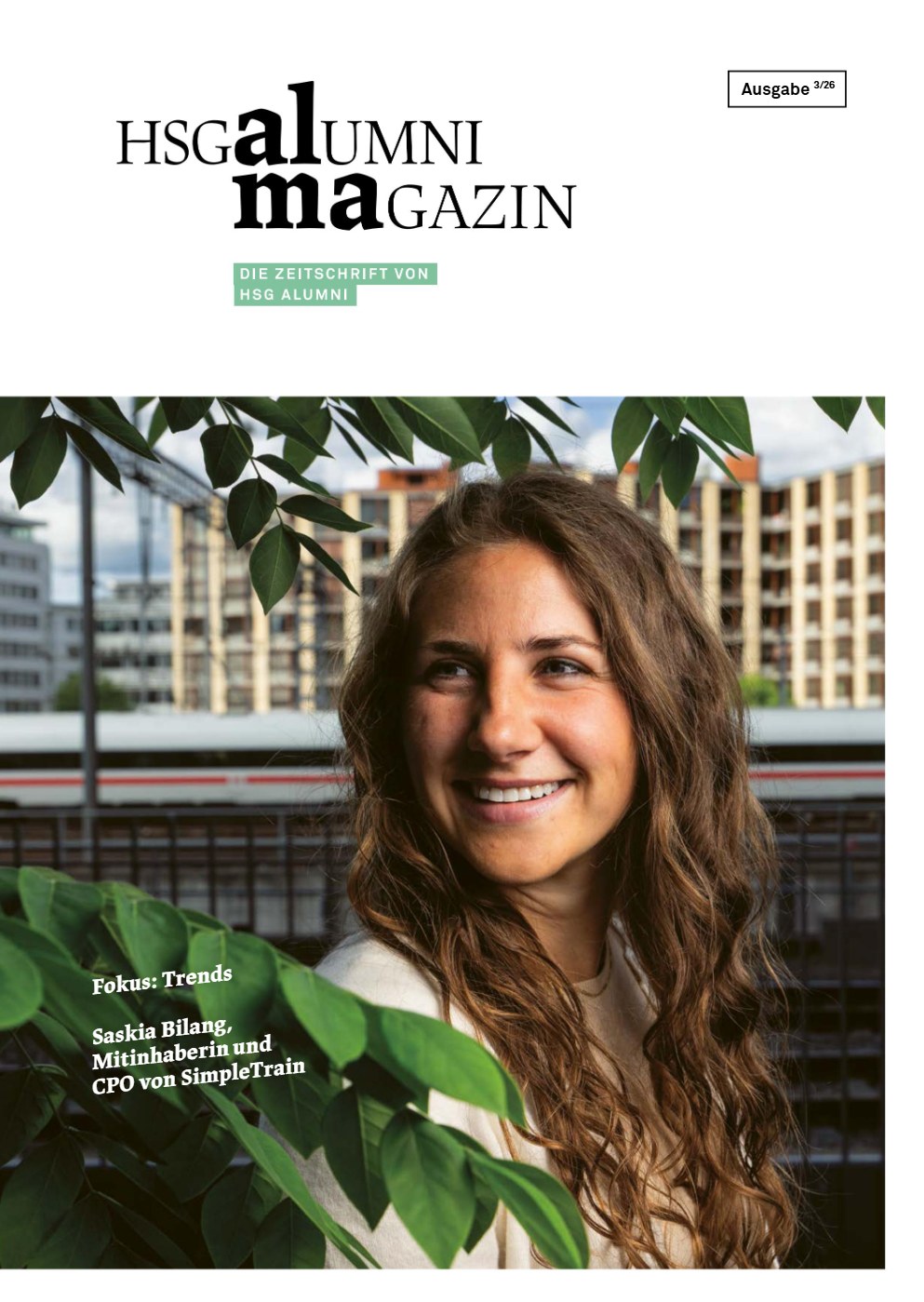
The latest issue of Alma (3/2026, “Trends”) features our work in its TechTonic column, titled “Der KI wachsen Ohren in Wasserkraftwerken” (“AI grows ears in hydropower plants”).
Alma is the quarterly member magazine of HSG Alumni, the alumni association of the University of St. Gallen, bringing community news and developments from the university to its members. With over 45,000 members, HSG Alumni is one of the largest and most active alumni associations in Europe, so the column brings our hydropower work to decision-makers in business and industry, well beyond the usual academic circles.
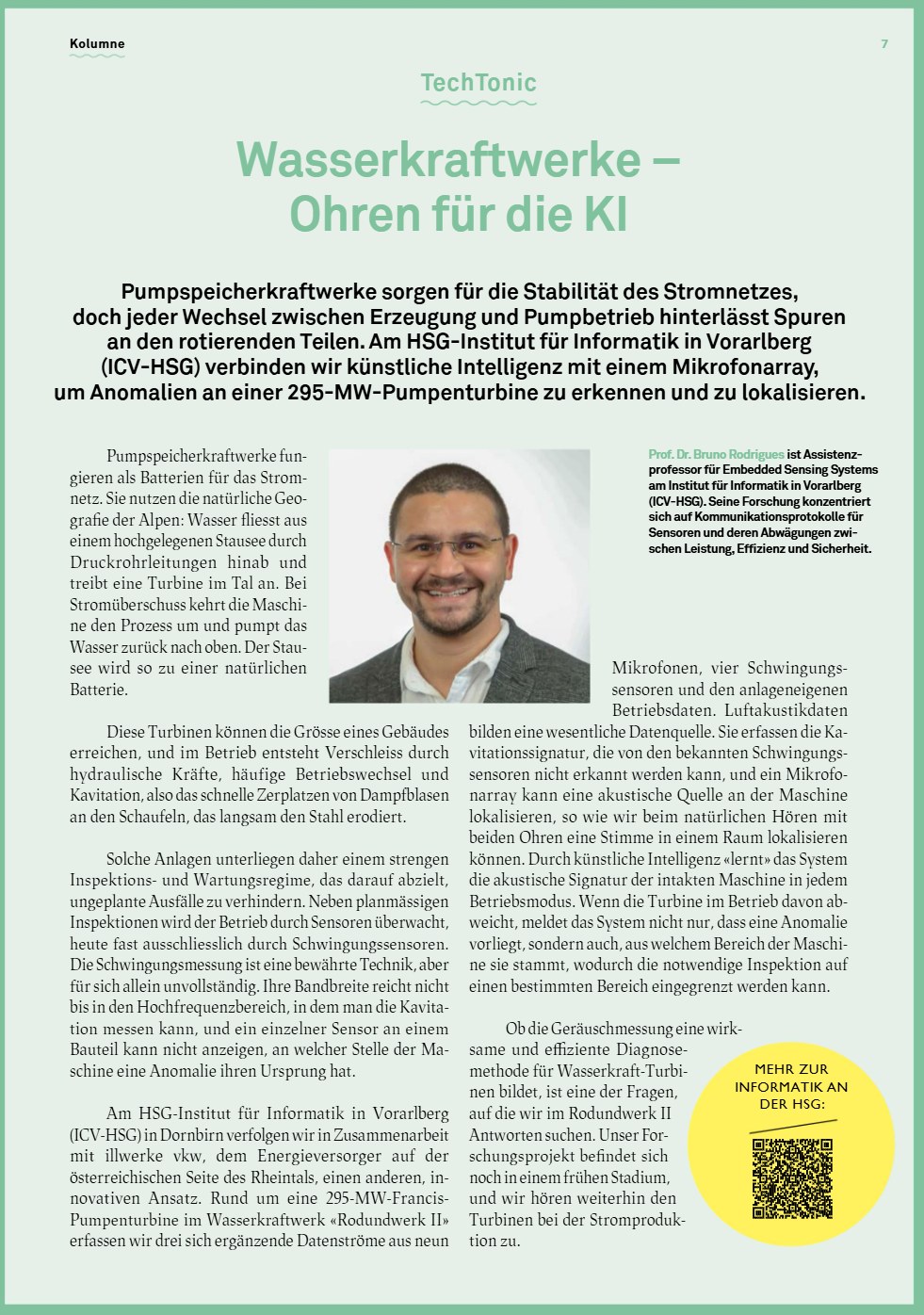
Written for a general audience, the column explains why pumped-storage plants are hard to monitor. They act as batteries for the grid, and years of switching between generating and pumping take a toll on the rotating parts. The established tool is vibration sensing, which is proven but incomplete: it captures only part of what a machine reveals, and a single sensor cannot tell where on the machine a change originates.
Together with illwerke vkw, the energy utility on the Austrian side of the Rhine valley, we take a different approach on a 295 MW Francis pump turbine at the Rodundwerk II power station: we combine a nine-microphone array, four vibration sensors, and the plant’s own operating data. The array adds an acoustic view that vibration alone does not capture, and, much like hearing a voice with two ears, it can localize where a sound on the machine comes from. Machine learning learns the healthy signature in each operating mode, so when the turbine drifts the system flags not only that something is off, but which part it comes from, narrowing the inspection.
For us, the collaboration matters as much as the method. It brings university research together with Vorarlberg’s energy industry, keeps knowledge and talent in the region, and puts research to work on infrastructure that a renewable-energy grid depends on. Strengthening this kind of tie between research and local industry is central to what we do at ICV-HSG. The project is at an early stage, and we keep listening.
We warmly thank Bernhard Fässler and Arne Schacht at illwerke vkw for their input and close collaboration. The joint study will be presented together at Viennahydro 2026.
Read the column in Alma 3/2026 on Issuu.
More on this line of work, part of our passive sensing research:
- The joint study with illwerke vkw, Multi-Modal Acoustic-Vibration Array Monitoring for Anomaly Detection and Source Localization in a Pumped-Storage Turbine, was accepted at Viennahydro 2026.
- The Vorarlberger Nachrichten covered the project in the WISTO series: an early-warning system for hydropower plants.
- Two Master’s theses contributed to this line: Zakaria Omarar on multimodal fault localization in hydropower and Maximilian Huwyler on a distributed acoustic-vibration testbed.
- Our comparative study of acoustic anomaly detection in pumped-storage plants, From Noise to Knowledge, won the Best Paper Award at the LongevIoT workshop of ACM IoT 2025.
- Where it began: acoustic sensing for predictive maintenance at the 2nd ICV-HSG CC-Workshop in December 2024.
Copy & share
Edit if you like, then copy and paste into your post.