

Midterm: Can My Network Tell How I Feel?
At the Bachelor project midterm session on Wednesday, 7 October, Karla Ruggaber and Thierry Suhner presented the progress of their project Can My Network Tell How I Feel?, on explainable depression indicators from network traffic metadata.
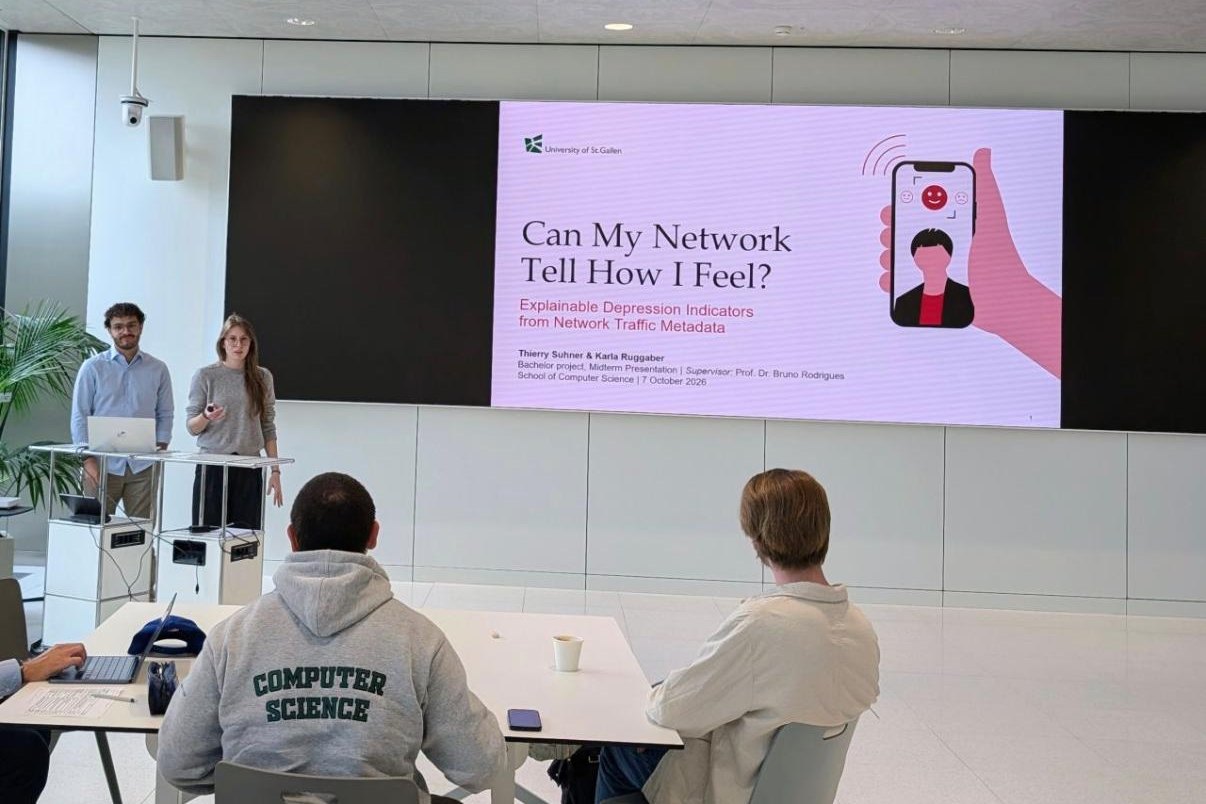
Depression develops gradually, and the delay until first treatment can be years. Active monitoring burdens patients, and passive monitoring is usually tied to one device or still needs interaction. The home network sees every device without anyone doing anything. Stephan Nef’s Master’s thesis already maps router metadata to the diagnostic criteria for depression, offline. The project takes that pipeline to live traffic, with three goals: it runs locally on live capture, it recognizes scripted behavioural profiles, and every reported likelihood can be traced back to the raw packets behind it.
The setup. Test devices connect through a Wi-Fi access point to a mini-PC acting as the network gateway. A capture tool written in Rust writes rotating packet captures and feeds the pipeline with metadata only, DNS queries and the server names visible in TLS and QUIC handshakes. Contents stay encrypted, and the captured metadata stays on the mini-PC.
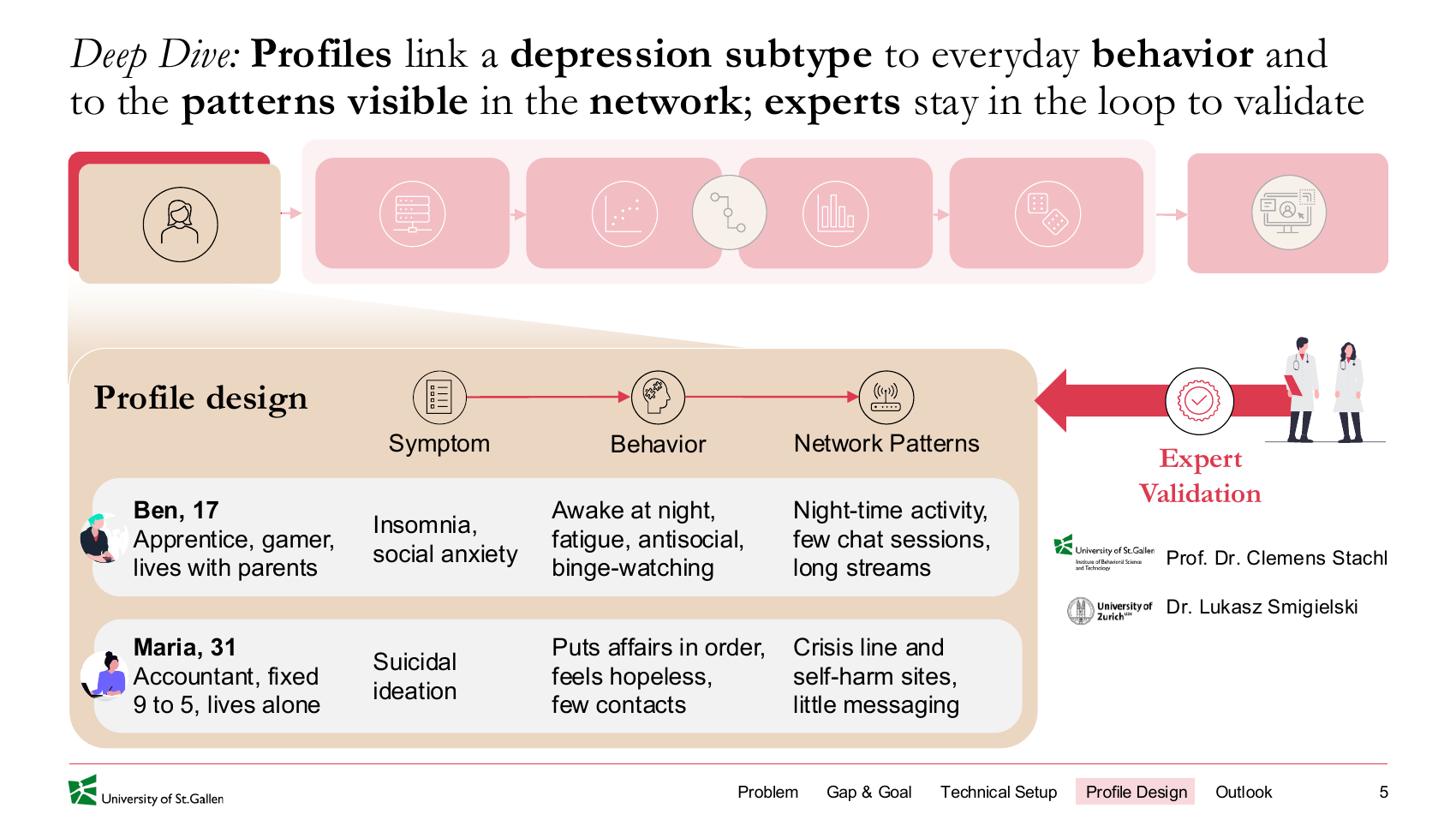
The profiles. Instead of recording real patients, the students design fictional personas, each linking a depression subtype to everyday behaviour and to the network patterns that behaviour would produce: night-time activity, few chat sessions, and long streams for insomnia and social anxiety, for example.
Next steps. Finalize the profiles, automate the pipeline, and evaluate it on three criteria: correctness (does the result match the intended symptoms), explainability (does each likelihood map back to raw packets), and usability (clinical feedback). The project closes with an explainable, user-friendly interface and a demo with real phones.
The midterm slides are available. The project builds on CareNet and on Tibor Haller’s Master’s thesis. Well done, Karla and Thierry!
Copy & share
Edit if you like, then copy and paste into your post.