

802.11bf and 802.11bi: What Are They About? Why Should I Care?
Every Wi-Fi device in the world, from your router to your phone, follows one rulebook: the IEEE 802.11 standard. Manufacturers build to it so that their devices work together, and the Wi-Fi Alliance certifies products against it. What the standard defines therefore ends up in billions of homes. Two new additions to it, 802.11bf and 802.11bi, matter for your privacy.
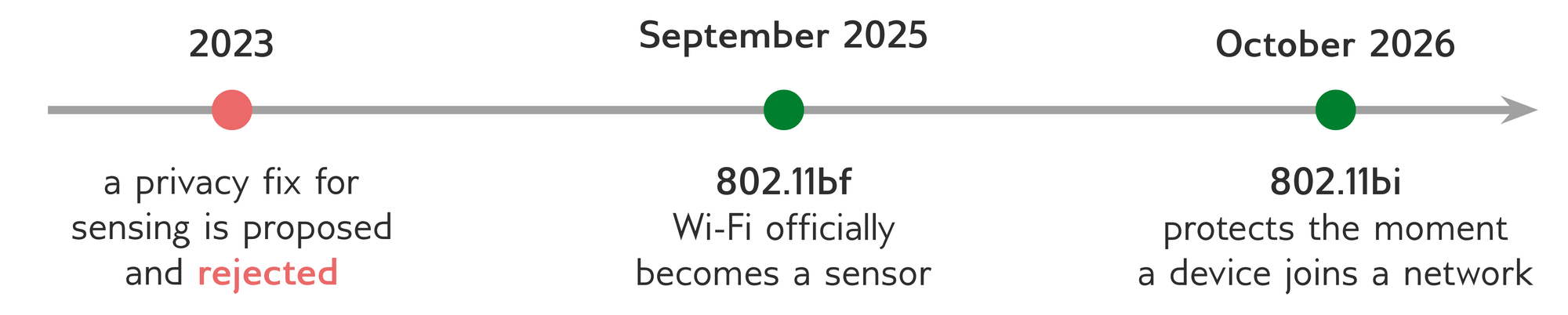
802.11bf: your router becomes a sensor
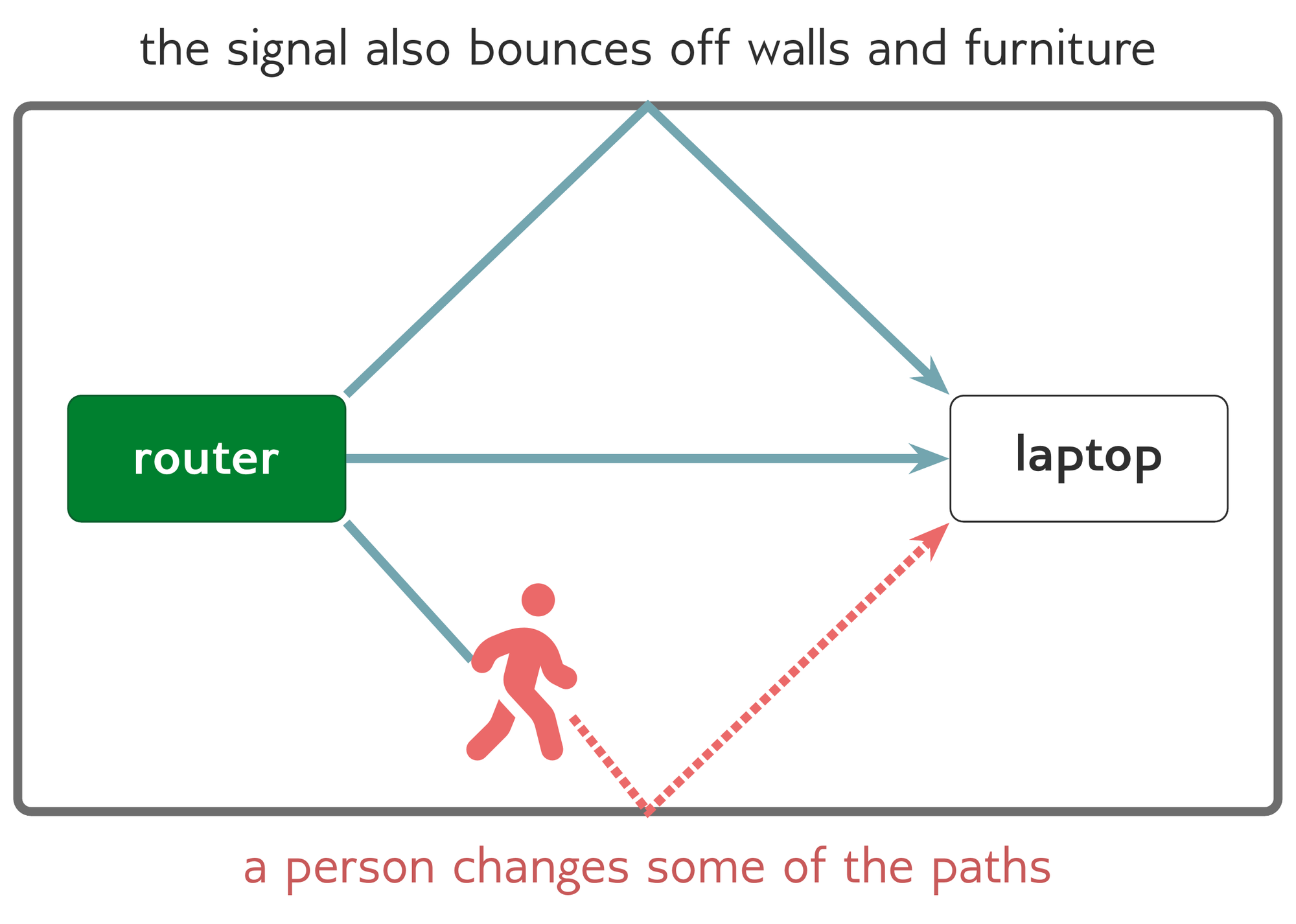
Wi-Fi signals bounce off walls, furniture and people, and every device measures how the signal changed on its way. When someone moves, these measurements change. Researchers have used this for years to detect presence, movement and even breathing. Since September 2025, 802.11bf makes it an official Wi-Fi function: the router decides which devices to measure and how often, and it receives all their reports. This enables useful services, such as alarms or fall detection for older people living alone, without cameras.
Router-based motion sensing is already on the market. Since August 2026, Comcast offers Wi-Fi motion detection on millions of its Xfinity home gateways. It is opt-in and off by default, but Comcast’s support page states that it “may be required to disclose information generated by WiFi Motion in response to a valid subpoena, court order, search warrant or other lawful legal process”. In Germany, Deutsche Telekom has field-tested the same idea on its Speedport routers.
While the standard was written, a proposal to protect privacy was rejected, because “the definition of sensing privacy is not clear”. The topic was handed over to the next amendment, 802.11bi. But that amendment changes how devices talk to each other, not what the radio signal reveals about a room.
802.11bi: one privacy patch
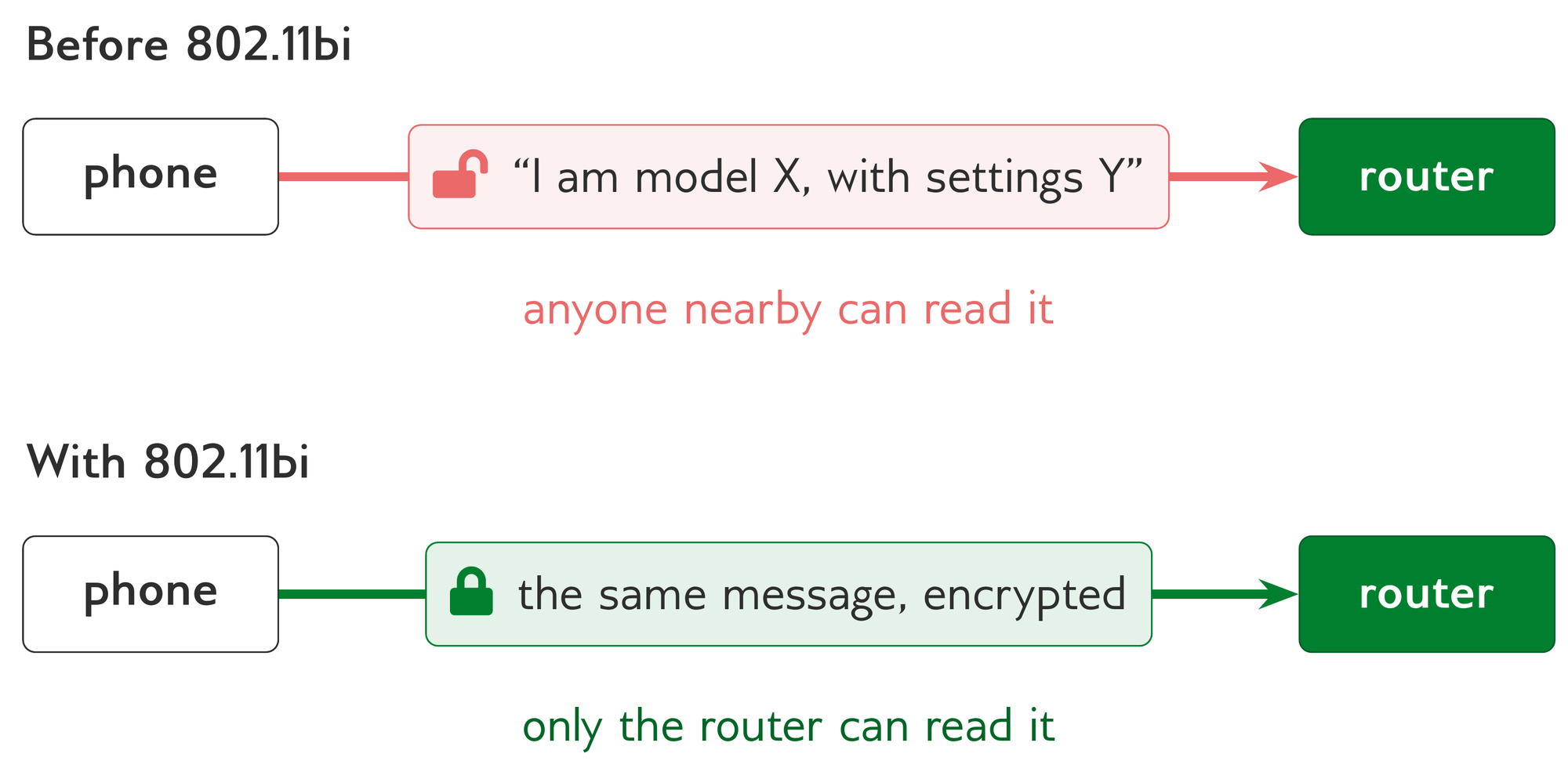
Phones already change their Wi-Fi address regularly, so that they cannot be followed from place to place, but that alone is not enough. Yet when a phone joins a network, it still describes itself in the open, and that description can identify it even after its address changes. Since October 2026, 802.11bi encrypts this first exchange. Further protections are described in the standard, but they are optional, and at the time of writing we know of no phone or laptop that ships them.
What a neighbour can still see
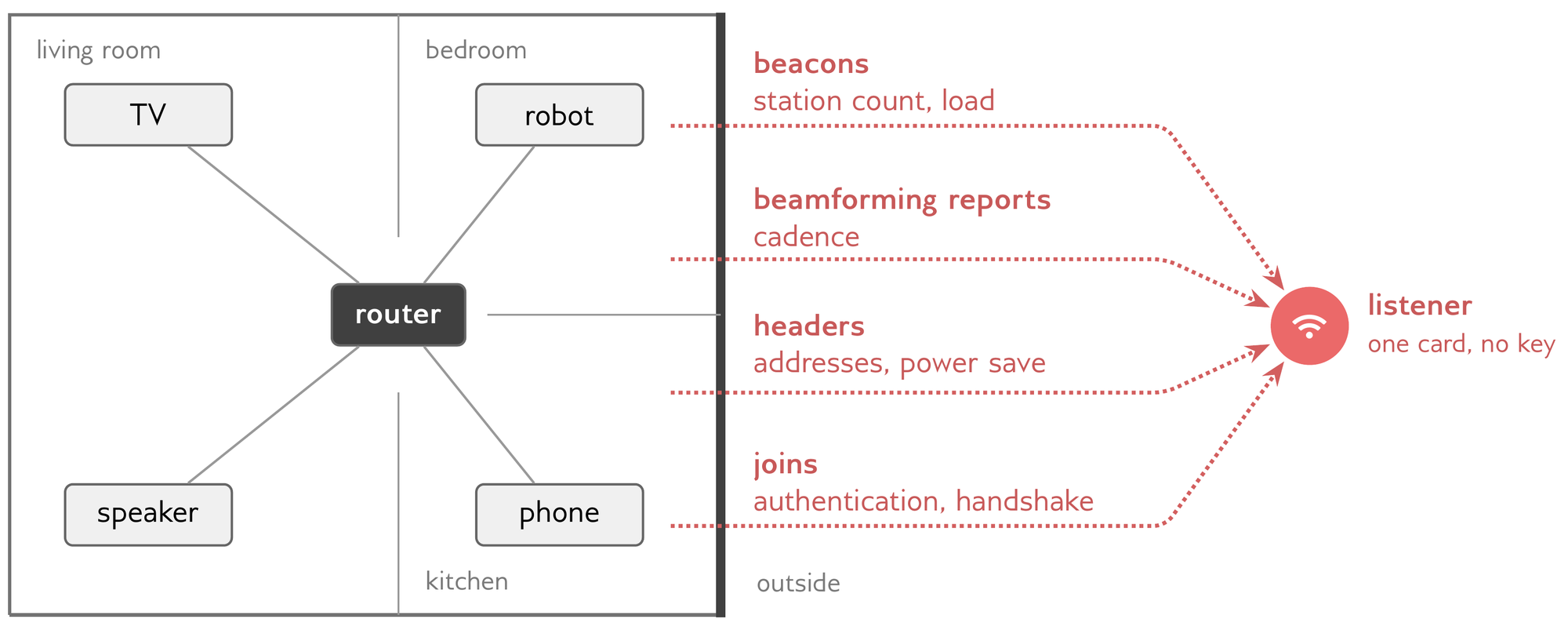
A neighbour with one ordinary Wi-Fi card, without your password, still sees a lot. Your router announces how many devices are connected. Every message shows which device is talking and when it sleeps. And the reports that devices send for beamforming describe the room, and change when someone moves in it. 802.11bi protects only the joining step: it hides the phone, but leaves the home talking.
Why should I care?
- Your router may soon notice you. Sensing is now a standard feature, and some internet providers already sell motion detection. Who keeps that data matters.
- Your TV may be watching the network too. In September 2026, an investigation by Gamers Nexus found that LG smart TVs repeatedly scan the home network and nearby Wi-Fi networks, collecting device names, addresses and signal strength. LG denied uploading data or recording audio, but confirmed the network scanning and called it a standard function of smart TVs.
- It is not only your router. Anyone within radio range can listen in, without joining your network.
- The new protection is partial. 802.11bi closes one leak, and only on devices that support it.
And companies? The same applies to offices, factories and hospitals, which run the same Wi-Fi. Someone in the parking lot can learn when a building fills and empties, which devices are inside, and which rooms are in use. Inside, a meeting-room TV that scans the network maps it for a third party. And a company that switches on sensing creates data about its employees, which data protection and workplace rules govern. Companies should know which of their devices sense or scan, and switch off what they do not need.
What does the law say?
It seems to depend on who is sensing whom.
- The GDPR (EU) protects personal data and treats health data, which could include breathing, as a special category with stricter rules. It does not seem to apply to purely private use within a household.
- The EU ePrivacy rules restrict access to information on users’ devices, and the European data protection authorities have published guidelines on their scope. Whether a router measuring radio signals falls under them does not seem settled.
- In Switzerland, the Telecommunications Act requires informing users about processing on their devices and letting them refuse, and the Data Protection Act governs personal data. Neither seems to mention Wi-Fi sensing explicitly.
- In the US, the Supreme Court ruled in Kyllo v. United States (2001) that pointing a thermal camera at a home is a search requiring a warrant, since “all details are intimate details” there, “at least where the technology is not in general public use”. The ruling binds the state, not companies, and Wi-Fi sensing now ships in millions of routers.
What these rules do not seem to cover clearly: visitors in a sensed home, who are neither customers nor users, and a neighbour who simply records the radio signals. They also seem to govern what is done with data once it is collected, not whether the radio carries the information in the first place.
Our group studies this gap: what a passive listener can still learn once the new protections are in place, for example in Nils Grob’s thesis. More in our FuSo talk slides.
References
- Wi-Fi Alliance. “Wi-Fi CERTIFIED.” wi-fi.org/certification
- Y. Ma, G. Zhou, S. Wang. “WiFi Sensing with Channel State Information: A Survey.” ACM Computing Surveys 52(3), 2019. doi:10.1145/3310194
- E. Yi, D. Wu, J. Xiong, F. Zhang, K. Niu, W. Li, D. Zhang. “BFMSense: WiFi Sensing Using Beamforming Feedback Matrix.” USENIX NSDI, 2024, pp. 1697-1712. usenix.org
- IEEE Std 802.11bf-2025. “Amendment 4: Enhancements for Wireless LAN Sensing.” IEEE, 2025. doi:10.1109/IEEESTD.2025.11184214
- The Register. “Comcast gives its Wi-Fi motion detector a security makeover.” 19 August 2026. theregister.com
- Xfinity. “WiFi Motion FAQs.” Comcast support page. xfinity.com
- N. Bölling. “So macht ein Hersteller einen WLAN-Router zum Bewegungsmelder.” t3n, 21 August 2026. t3n.de
- Y. Zhang, S. McCann. “LB272 Privacy Comments Resolution.” IEEE 802.11-23/1109r0, June 2023. mentor.ieee.org
- P. Piron. “WiFi Sensing and the Privacy Fix Its Committee Couldn’t Agree to Make.” 11 June 2026. pascalpiron.substack.com
- G. Geraci et al. “Wi-Fi: Twenty-Five Years and Counting.” arXiv:2507.09613, 2025. arxiv.org/abs/2507.09613
- IEEE Std 802.11bi-2026. “Amendment 5: Enhanced Service with Privacy Protection.” IEEE, 2026. standards.ieee.org
- R. Xiao, X. Chen, Y. He, J. Han, J. Han. “Lend Me Your Beam: Privacy Implications of Plaintext Beamforming Feedback in WiFi.” NDSS Symposium, 2025. doi:10.14722/ndss.2025.240005
- A. Lekander. “LG Smart TVs found scanning home networks for nearby devices.” CyberInsider, 7 September 2026. cyberinsider.com
- S. Warwick. “LG strongly denies TV spying claims, says tracking and snooping concerns ’not true’.” Tom’s Hardware, 9 September 2026. tomshardware.com
- Regulation (EU) 2016/679, General Data Protection Regulation. eur-lex.europa.eu
- European Data Protection Board. “Guidelines 2/2023 on Technical Scope of Art. 5(3) of ePrivacy Directive.” edpb.europa.eu
- Switzerland, Telecommunications Act (SR 784.10). fedlex.admin.ch
- Switzerland, Federal Act on Data Protection (SR 235.1). fedlex.admin.ch
- Kyllo v. United States, 533 U.S. 27 (2001). law.cornell.edu
Copy & share
Edit if you like, then copy and paste into your post.