

BC4CC: Blockchains for Cold Chains
Bruno Rodrigues' contribution to an Innosuisse project with modum.io: tamper-proof temperature records for medical drug shipments, stored on whichever blockchain fits each customer's cost and performance needs.
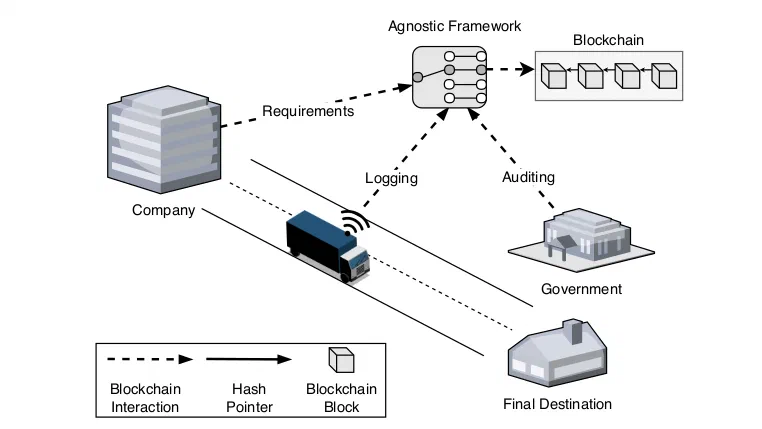
Many medical drugs must stay within a temperature range from the producer to the pharmacy, and European Good Distribution Practice rules require proof that they did. modum.io, a Zurich startup, built that proof into its product: a temperature logger travels with each shipment, signs its measurements in a hardware security module, and a hash of the record is anchored in a blockchain so that nobody along the chain can quietly rewrite it.
BC4CC was a University of Zurich project, led at the Communication Systems Group (CSG) by Prof. Burkhard Stiller and Thomas Bocek, in which CSG and modum.io tackled, with Innosuisse funding, the two obstacles that kept this from scaling. Bruno Rodrigues contributed as a doctoral student at CSG, co-authoring the project’s interoperability and blockchain-selection work and editing its final report. This page describes that contribution, not the wider project.
The problem: cost and lock-in
Supply chain is a natural use case for blockchains, yet productive deployments stayed rare. Two reasons came up again and again. Transaction fees add up quickly when every shipment writes to a public chain, and companies feared locking their whole solution into one blockchain that might not become the standard. A producer cares most about how fast and how securely a record is committed; a logistics provider that logs temperatures all day cares most about cost. One chain cannot serve both.
Bifröst: one API, many blockchains
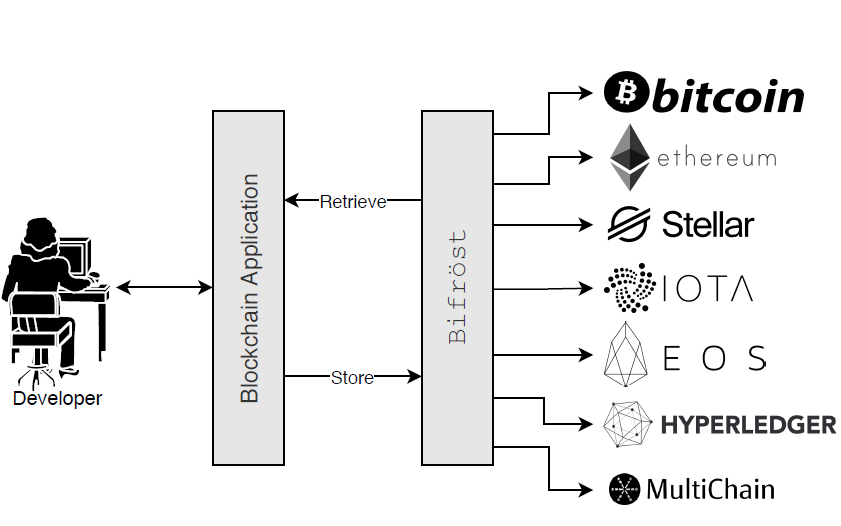
Bifröst is a modular interoperability API built on a notary scheme. An application calls three functions, store, retrieve, and migrate, and never touches the underlying chain: each blockchain sits behind an adapter with a standard interface, so adding a new one means writing one adapter. The prototype supported Bitcoin, Ethereum, EOS, Stellar, IOTA, Hyperledger, and MultiChain, plus a PostgreSQL fallback, and was integrated into modum.io’s demonstration environment. It was published at IEEE LCN 2019 (Bifröst: a Modular Blockchain Interoperability API).
PleBeuS: let a policy pick the chain
PleBeuS applies policy-based management to the choice of blockchain. A customer states its requirements once, as policies: public or private, minimum throughput, block time, data size, a spending cap per day, week, month, or year, and a performance or economic profile. For every record, PleBeuS selects the chain that satisfies the active policy, and switches policy automatically when a cost threshold is reached. In evaluations with 10,000 transactions per scenario, it switched policies as each budget was reached and steered data to the fastest or cheapest eligible chain. It was published at IEEE/IFIP NOMS 2020 (PleBeuS: a Policy-based Blockchain Selection Framework), following the short paper “Toward a Policy-Based Blockchain Agnostic Framework” at IFIP/IEEE IM 2019.
What the project showed
The technology worked; adoption was the harder part. Over the project, the industry moved toward private and consortium blockchains rather than public ones, and modum.io’s production system followed. The project’s conclusion was that a blockchain-agnostic layer lowers the barrier to adoption and avoids lock-in, but that it competes with the status quo and with closed consortium networks. The project also produced a security whitepaper on edge-to-chain integrity for IoT temperature loggers: the record is only as trustworthy as the device that signs it.
What the group builds on it
BC4CC is where trustworthy data from constrained devices met distributed ledgers and policy management. That thread continues in the group’s network and systems security line, in decentralised governance for cooperative defence, and in the question every sensing deployment faces: how to make a measurement verifiable from the sensor onward.