

E2C: Energy Efficiency to Clouds
Bruno Rodrigues' contribution to a University of São Paulo and Ericsson Research project that extended sustainability-oriented network policies to cloud data centres, letting users pick green service plans that trade energy for performance.
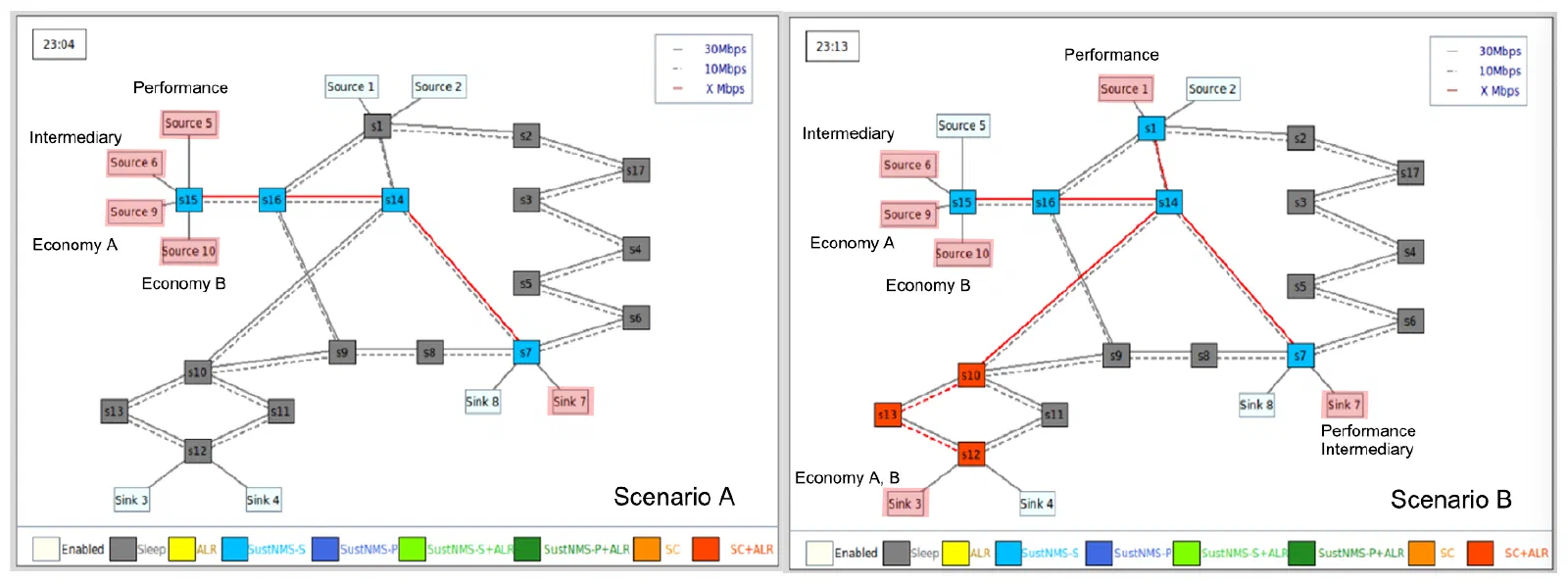
A cloud data centre spends energy on its servers and on the network that connects them. Not every customer needs the fastest possible service at every moment, and some would gladly accept a slower one if it consumed less energy. E2C asked how a provider could offer that choice, and keep the promise, across both the network and the compute resources of a data centre.
E2C was the follow-up to SOS, again a joint project of the Laboratory of Sustainability in ICT (LASSU) at the University of São Paulo, led by Prof. Tereza Carvalho, and Ericsson Research, with Catalin Meirosu. Where SOS orchestrated energy-saving features in a network, E2C extended that approach to the network inside a data centre and to the servers attached to it. Bruno Rodrigues worked on it from the end of his Master’s until he left for his PhD at the University of Zurich in 2016, also taking on the technical coordination of the research group. This page describes that contribution, not the wider project.
Green plans: sustainability as a service tier
The central idea was to let users choose among green plans, service levels with distinct requirements on energy consumption, much as they choose among performance tiers today. Bruno extended the GreenSDN environment from SOS to support such users, and developed the policy enforcement points for network and compute resources that make each plan hold in practice.
A green plan is only credible if the provider can tell how much energy each customer actually used. The SDN controller presented at SBRC 2016 manages three green service levels with different energy requirements, and accounts for each user’s power consumption with power models of the network and its energy saving capabilities, giving a fine-grained view of who consumed what in each usage scenario. It was validated by emulating two use cases inspired by the Facebook network topology.
Offering green plans across a whole infrastructure also needs a common way to describe the energy saving capabilities involved, which were developed independently for particular layers and devices and can interact with each other and with quality of service functions. The project proposed SLIM, the SustainabiLity Information Model for Energy Efficiency Policies, an add-on to the IETF Policy Core Information Model Extension that unifies the management of these capabilities throughout the network, and illustrated it with an energy management system where SLIM was used (IEEE Communications Magazine, 2016).
Patents with Ericsson
The project’s ideas were filed as three international patent applications with Ericsson:
- Software-defined power management for network resources (WO2017009689A1): users select an energy policy, each policy carries a budget in a virtual currency, and a virtual power controller configures, monitors, and adjusts the energy saving capabilities on the network resources that serve them.
- Managing the power of a data centre (WO2018009103A1): predict the compute and memory a data centre will need from the characteristics of its incoming traffic, and derive the power consumption of individual virtual machines from that prediction.
- Setting processor frequency and voltage from traffic (WO2018013023A1): buffer the packets arriving for a server’s virtual machines, predict the compute they will require, and choose the processors’ frequency and voltage (DVFS) before releasing them.
Publications
- A. C. Riekstin, B. B. Rodrigues, V. T. Nascimento, C. B. Progetti, T. C. M. B. Carvalho, and C. Meirosu. “Sustainability Information Model for Energy Efficiency Policies.” IEEE Communications Magazine, 54(11), 2016.
- B. B. Rodrigues, M. A. T. Rojas, V. T. Nascimento, T. C. M. B. Carvalho, and C. Meirosu. “Green Service Levels in Software Defined Networks.” Brazilian Symposium on Computer Networks and Distributed Systems (SBRC), 2016.
- B. B. Rodrigues. “GreenSDN: Energy Efficiency in Software Defined Networks.” Master’s thesis (PDF), Polytechnic School, University of São Paulo, 2016. Advisor: Prof. Tereza C. M. B. Carvalho.
What the group builds on it
E2C framed energy as something a user can choose and a provider must account for, per customer and per resource. That habit of tying a measurement to the party it belongs to, and of enforcing a stated policy rather than a fixed configuration, carried into BC4CC and the group’s later work on trustworthy data from distributed devices.