

SOS: Sustainability Oriented Policies based on Dynamic Policies with Automated Policy Refinement
Bruno Rodrigues' contribution to a University of São Paulo and Ericsson Research project: orchestrating a network's energy-saving features from business-level sustainability policies, tested on GreenSDN, the energy-aware SDN testbed he built.
Network equipment had gained many ways to save energy: links that slow down when traffic is light, interfaces that sleep between bursts, routing that packs traffic onto fewer devices so others can be switched off. Each one was designed on its own, for one layer of the network. Switched on together, they can add up to larger savings, or work against each other, and a feature that suits a quiet network causes congestion and packet loss in a busy one. Operators had no systematic way to decide which ones to run, when, and in which combination.
SOS addressed that problem. It was a joint project of the Laboratory of Sustainability in ICT (LASSU) at the University of São Paulo, led by Prof. Tereza Carvalho, and Ericsson Research, with Catalin Meirosu. The method at its core was the doctoral work of Ana Carolina Riekstin (PhD thesis, USP, 2016). Bruno Rodrigues joined toward the end of the project, as a Master’s student, and contributed the testbed on which SOS was run. This page describes that contribution, not the wider project.
The method: from business policy to network action
SOS starts from policy-based network management: an operator writes high-level goals, for example to save energy without breaking a performance target, and a refinement process translates them down to concrete settings on the devices. The project surveyed existing policy refinement methods and the requirements that sustainability goals add to them (IEEE Communications Surveys & Tutorials, 2016). The orchestration method then combines the available energy efficiency capabilities while avoiding the combinations that conflict, using a utility function to weigh energy savings against performance and a decision tree that picks the best option for the current bandwidth utilisation, topology, and power profile of the devices.
GreenSDN: a testbed for energy-saving networks
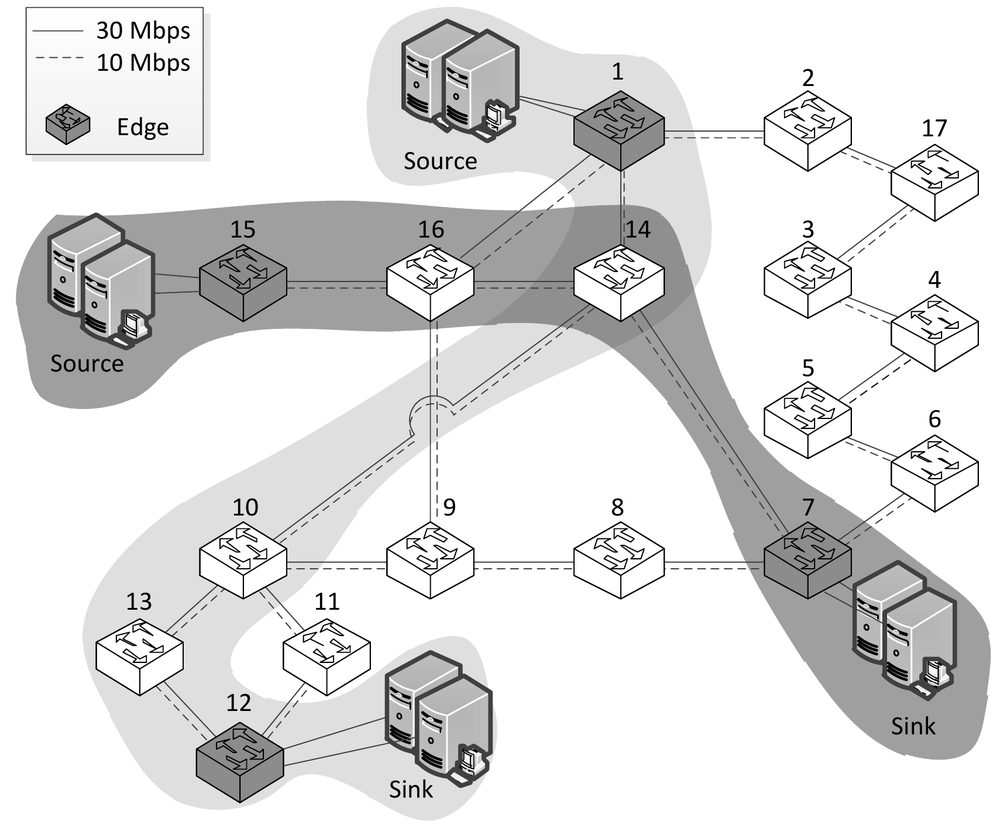
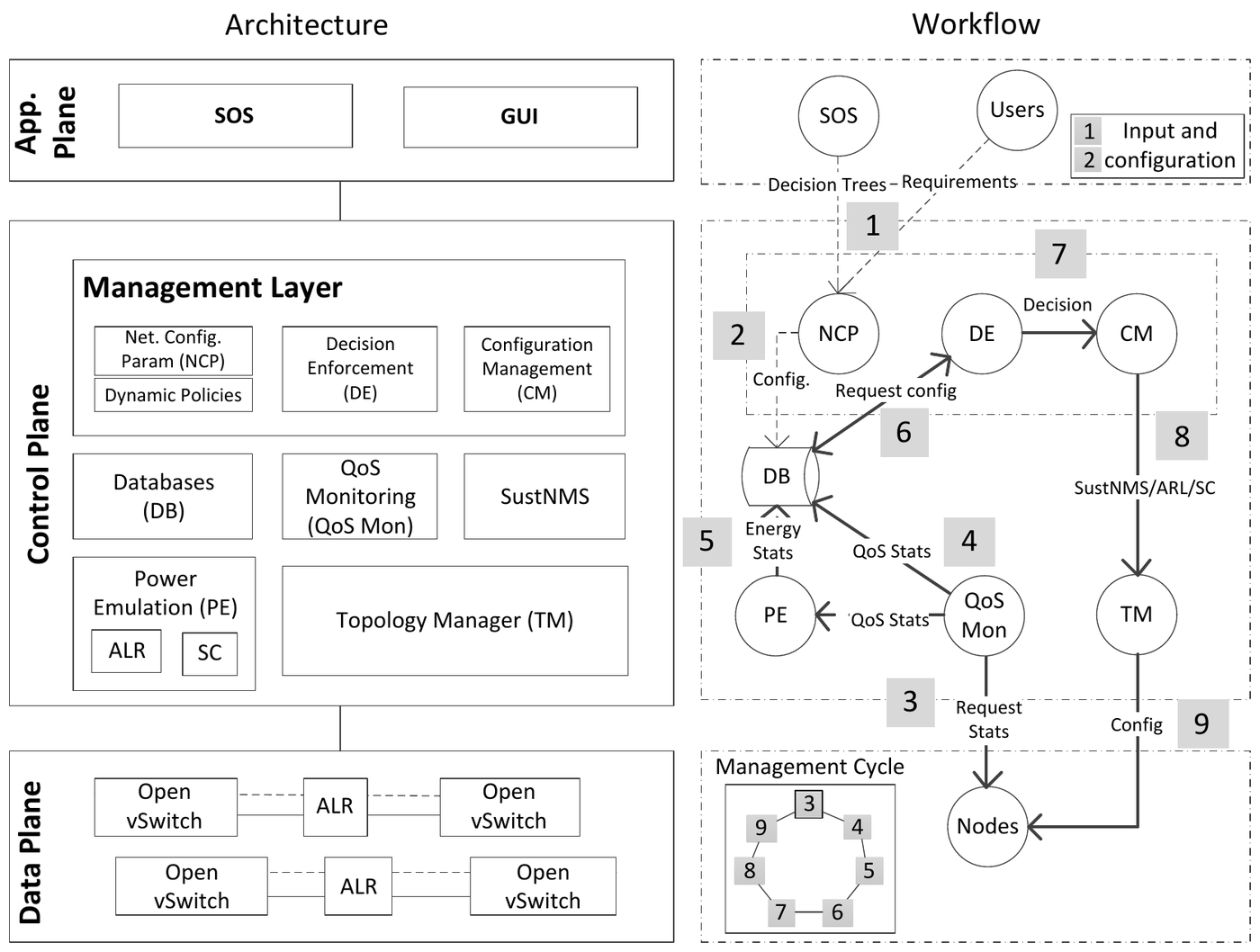
The experiments confirmed the project’s premise: orchestrating several capabilities together yields additional savings over any single one, while keeping their operation free of conflicts.
Publications
- B. B. Rodrigues, A. C. Riekstin, G. C. Januário, V. T. Nascimento, T. C. M. B. Carvalho, and C. Meirosu. “GreenSDN: Bringing Energy Efficiency to an SDN Emulation Environment.” IFIP/IEEE International Symposium on Integrated Network Management (IM), 2015.
- A. C. Riekstin, B. B. Rodrigues, G. C. Januário, V. T. Nascimento, T. C. M. B. Carvalho, and C. Meirosu. “A Demonstration of Energy Efficiency Capabilities Orchestration in Networks.” IFIP/IEEE International Symposium on Integrated Network Management (IM), demonstrations, 2015.
- A. C. Riekstin, G. C. Januário, B. B. Rodrigues, V. T. Nascimento, M. R. Pirlea, T. C. M. B. Carvalho, and C. Meirosu. “Orchestration of Energy Efficiency Functionalities for a Sustainable Network Management.” IEEE International Symposium on Network Computing and Applications (NCA), 2014.
- A. C. Riekstin, G. C. Januário, B. B. Rodrigues, V. T. Nascimento, T. C. M. B. Carvalho, and C. Meirosu. “A Survey of Policy Refinement Methods as a Support for Sustainable Networks.” IEEE Communications Surveys & Tutorials, 18(1), 2016.
- A. C. Riekstin, G. C. Januário, B. B. Rodrigues, V. T. Nascimento, T. C. M. B. Carvalho, and C. Meirosu. “Orchestration of Energy Efficiency Capabilities in Networks.” Journal of Network and Computer Applications, 59, 2016.
- B. B. Rodrigues. “GreenSDN: Energy Efficiency in Software Defined Networks.” Master’s thesis (PDF), Polytechnic School, University of São Paulo, 2016. Advisor: Prof. Tereza C. M. B. Carvalho.
What the group builds on it
SOS was Bruno’s first encounter with two ideas that kept returning. One is policy-based management: stating what an operator wants once and letting the system choose how, which reappeared in BC4CC as policy-driven blockchain selection. The other is the value of a testbed that makes an idea measurable before it meets a production network, an approach the group still follows with its WiFi sensing mesh and its plant deployments. The follow-up project, E2C, carried SOS into cloud data centres.