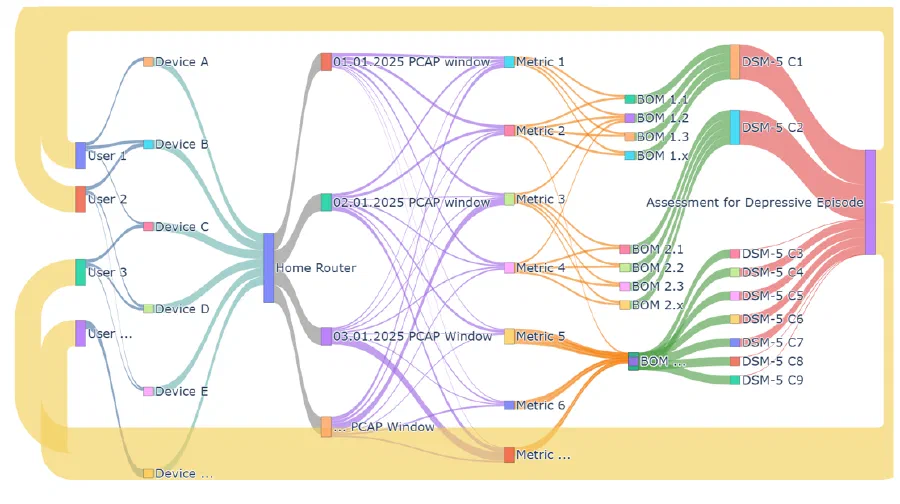
Every home already has a passive behavioral sensor: the router. CareNet asks what it can responsibly reveal about mental health from nothing but the packet headers it sees at the gateway. The insight is that ordinary metadata, when someone first comes online, how varied their activity is, whether daily routines hold, tracks the same behavioral shifts clinicians associate with depression. Rather than a black-box score, CareNet maps these signals to the nine DSM-5 depressive-symptom criteria through the Fuzzy Additive Symptom Likelihood (FASL): transparent fuzzy memberships, explicit weights, and a DSM-style temporal gate, so every daily readout traces back to the behavior behind it. It runs entirely on local header metadata, resolves per-user traffic in multi-person households, and never inspects payloads. The goal is not diagnosis but a starting point for early, empathetic conversations, backed by an open-source pipeline and an interactive dashboard that follows each household’s traffic all the way to its DSM-5 indicators.