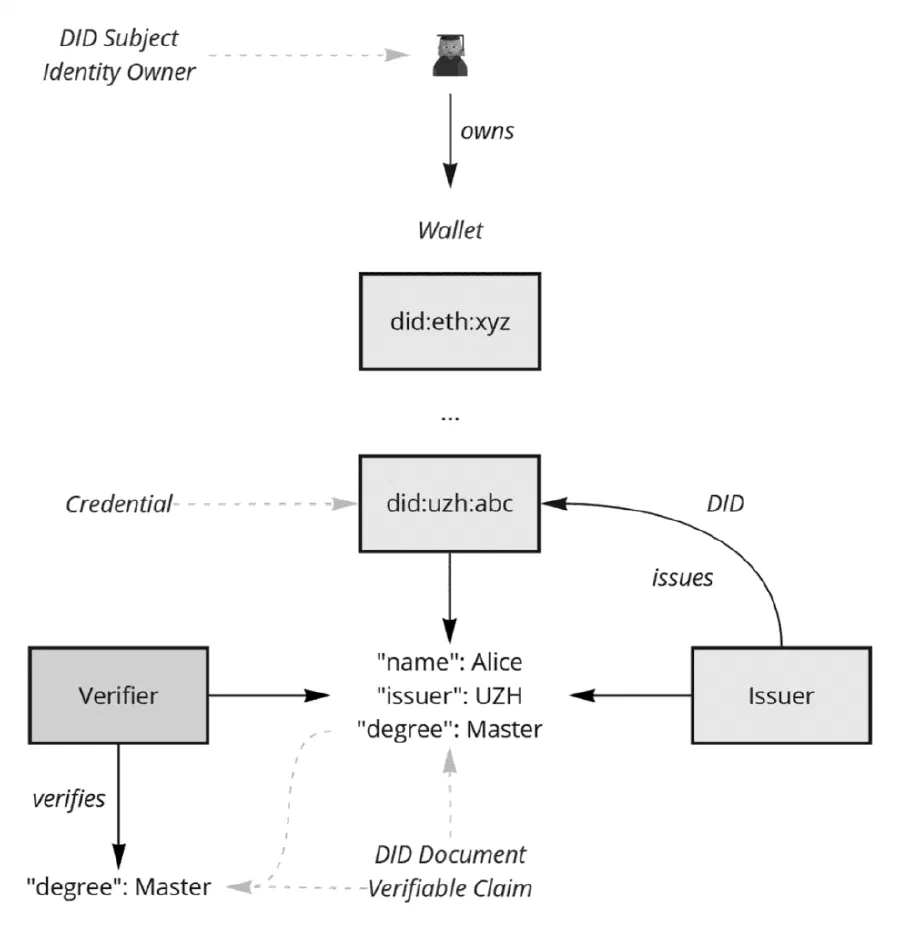
Digital identity is the entry ticket to most online services, yet the personal data behind it still sits with governmental and commercial providers, scattered across silos that invite identity theft, data misuse and breaches that users rarely learn about. This chapter surveys how blockchains can carry identity instead. It lays out the fundamentals of digital identity, the decentralized identifier and verifiable credential standards, the Self-Sovereign Identity (SSI) frameworks built on them, and the real-world initiatives that have adopted them. It then asks why decentralized identity is still not part of everyday life and traces the contributing factors. The chapter is open access (CC BY-NC-ND 4.0) in the De Gruyter Handbook of Blockchain and Society, edited by John Flood and Lachlan Robb.
Cite this paper (BibTeX)
@incollection{schumm2026-digital-identity-blockchains,
  author    = {Daria Schumm and Bruno Rodrigues and Burkhard Stiller},
  title     = {{Digital Identity and Blockchains: A Comprehensive Overview of Approaches}},
  booktitle = {De Gruyter Handbook of Blockchain and Society},
  year      = {2026},
  editor    = {John Flood and Lachlan Robb},
  publisher = {De Gruyter},
  chapter   = {4},
  pages     = {63--80}
}