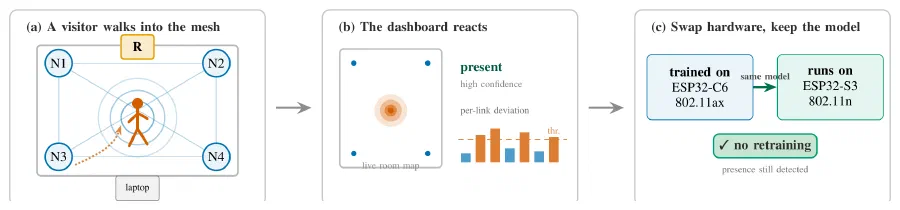
A live booth version of OpenCSI, built so that attendees can see a calibration layer at work rather than read its numbers. An ESP32 mesh senses the space in front of the table, and a real-time dashboard shows the mesh topology, each link’s calibration maturity as its baseline forms, and the occupancy decision as a visitor steps into the sensing volume. The centerpiece is a physical hardware swap: the mesh is rebuilt from ESP32-C6 to ESP32-S3 nodes, changing chip generation, band, and PHY format, and the same unchanged classifier keeps detecting occupancy with no retraining and no labelled data from the new hardware. Unplugging a node or moving a chair then breaks calibration on purpose, and the dashboard flags the stale links instead of failing quietly. Where most WiFi sensing demos show a downstream task on fixed hardware, this one exposes the layer beneath, and makes cross-hardware transfer observable through a live swap rather than reported metrics.
@inproceedings{khamaisi2026-opencsi-demo,
  author    = {Karim Khamaisi and Simon Sigg and Bruno Rodrigues},
  title     = {{Demo: OpenCSI: A Self-Calibrating, Cross-Hardware WiFi Sensing Mesh}},
  booktitle = {IEEE Conference on Local Computer Networks (LCN), Demonstrations},
  year      = {2026},
  address   = {Coimbra, Portugal},
  url       = {https://sensing-group.com/files/papers/2026-lcn-opencsi-demo.pdf}
}