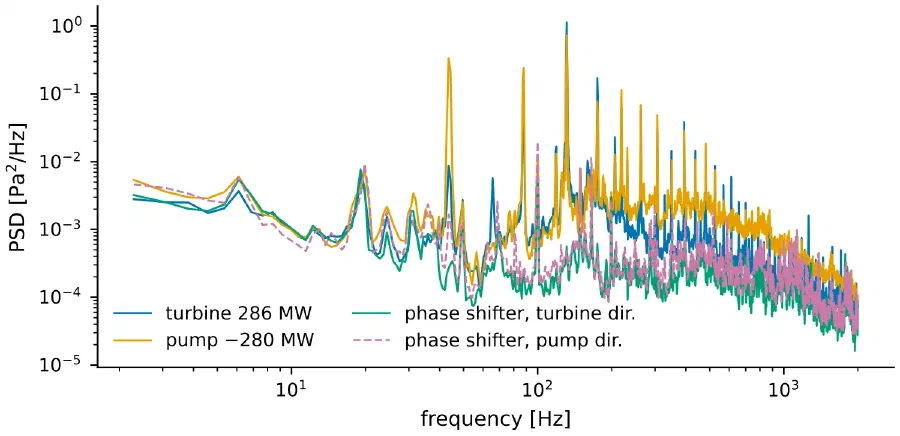
Pumped-storage machines absorb the volatility of wind and solar, and they pay for it in frequent mode changes and wear. Condition monitoring rests on vibration and plant data: industrial accelerometers roll off near 3.7 kHz, and both pillars observe the machine from fixed points, so airborne acoustics at full scale is still barely characterized. This study instruments a 295 MW pump-turbine at Rodundwerk II with nine microphones and six vibration channels, records five days of synchronous data (about 38 hours), models healthy behavior per operating mode from unlabeled recordings, and reports deviations with calibrated confidence. Since a fault cannot be induced in a live machine, detection and localization are validated on 180 logged hammer strikes at twelve positions, each located event reported as a ±20 degree sector rather than a point. The result is a measured field baseline for what an acoustic array adds over vibration, and where it does not. To appear at the International Seminar on Hydropower Plants (Viennahydro) 2026.
@inproceedings{zhang2026-viennahydro-multimodal-array,
  author    = {Jinyuan Zhang and Stefan Krummenacher and Zakaria Omarar and Arne Schacht and Bernhard Fässler and Bruno Rodrigues},
  title     = {{Acoustic-Vibration Anomaly Detection and Localization at a Pump-Turbine}},
  booktitle = {International Seminar on Hydropower Plants (Viennahydro)},
  year      = {2026},
  address   = {Vienna, Austria},
  url       = {https://sensing-group.com/files/papers/2026-viennahydro-multimodal-array.pdf}
}