

Passive & physical-layer sensing
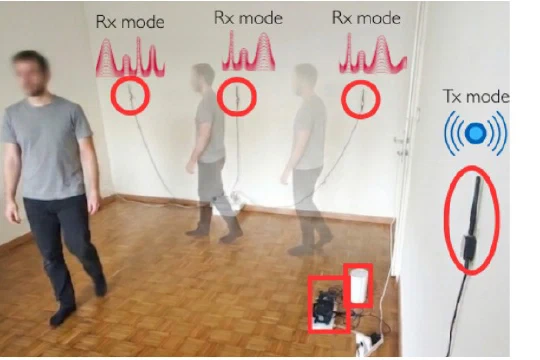
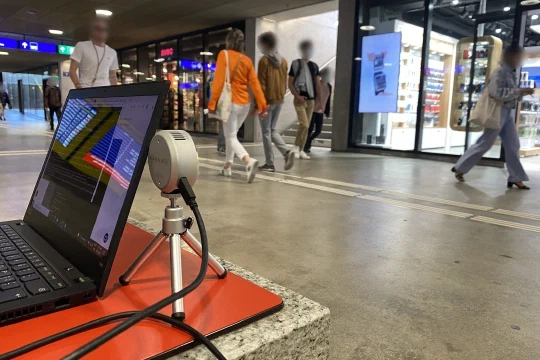
Everyday signals carry far more information than they were meant to. The Wi-Fi channel between two devices bends around a person walking through a room; a machine about to fail sounds different long before it stops; a home router sees the rhythm of a household without ever reading its content. We aim to design systems that read these ambient signals, Wi-Fi channel state information, RF and Bluetooth, acoustics and vibration, and turn them into an understanding of people, activity, and machines, using the sensors a space already contains rather than new cameras or wearables.
A model that reaches high accuracy in one room, on one device, or on one machine typically fails in a different one. We treat that gap as missing theory, not a tuning problem. Our work separates what in a signal is artifact, chip gain, room geometry, plant noise, from what is genuine information, and asks what each modality can provably reveal, and what it must give up in exchange for robustness, portability, or privacy.
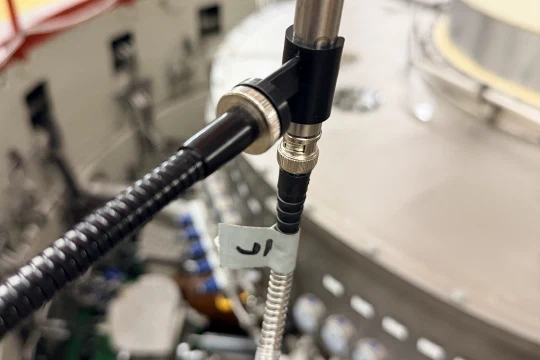
As such, in a Wi-Fi mesh of seventy-two links, three carefully chosen links outperform all seventy-two by twenty-four percent: more sensors can mean less information. A single normalisation makes channel-state models transfer across different chips and rooms without retraining, yet the same step provably erases the magnitude that finer discrimination would need, portability bought at a measurable price. In industrial acoustics, models trained on generic data fail on a real pumped-storage turbine, so we build detectors and self-calibration that hold up in the field. And across router metadata, speech, and vibration, we insist the output be interpretable: a falsifiable mapping to a clinical or physical indicator, not an opaque score.
Selected publications
- Towards Interpretable Depression Detection: Linking Acoustic Features to DSM-5 Indicators 2026
- CareNet: Linking Home-router Network Traffic to DSM-5 Depressive Behavior Indicators 2026
- Demo: OpenCSI: A Self-Calibrating, Cross-Hardware WiFi Sensing Mesh 2026
- OpenCSI: Self-Calibration Layer for Heterogeneous Mesh Wireless Sensor Networks 2026
- Acoustic-Vibration Anomaly Detection and Localization at a Pump-Turbine 2026
- Demo: Tracing a DSM-5 Depression Assessment from Score to Formula on Edge Hardware 2026
- Beyond Training: A Personalized Holistic Injury Prediction in Triathletes 2025
- From Noise to Knowledge: A Comparative Study of Acoustic Anomaly Detection Models in Pumped-storage Hydropower Plants 2025