

BATradar: Acoustic Drone Localization Engine
Abstract
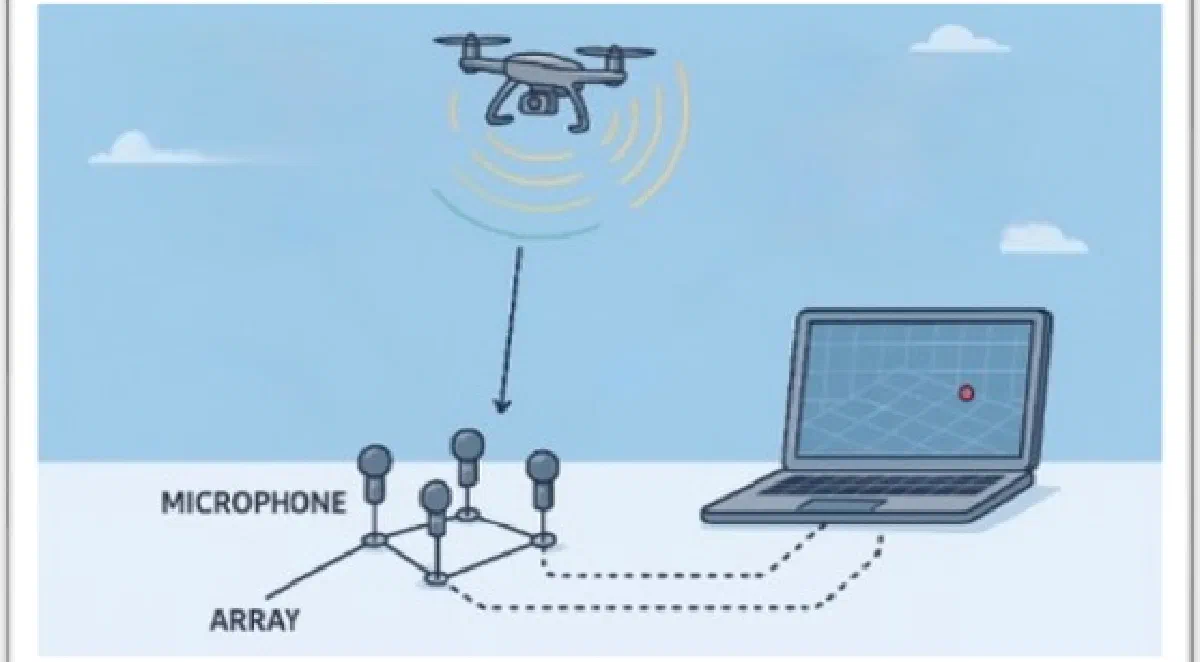
Amidst the rising popularity of unmanned aerial vehicles (UAVs) in various areas such as recreational videography, but also surveillance and warfare, the need for advanced techniques to detect and localize drones has become increasingly crucial. Conventional monitoring methods, such as radio frequency (RF) tracking, often face significant challenges as they rely on active signal transmission, which may be absent in autonomous drone operations. This creates a critical demand for passive, non-line-of-sight identification methods. In this paper, a localization program for drones is introduced that works solely based on acoustic signals. Our system, BATradar, utilizes a specialized three-step pipeline comprising Time Difference of Arrival (TDOA), Direction of Arrival (DOA), and multilateration algorithms. By leveraging Recurrent Neural Networks (RNN) and Mel-frequency Cepstral Coefficients (MFCCs), the engine is designed to reliably identify unique acoustic signatures even in environments with low signal-to-noise ratios. Our experimental evaluation demonstrates that a Recurrent Neural Network (RNN) architecture achieves a detection accuracy of over 99% in quiet environments and remains robust under low signal-to-noise conditions. However, while the system shows high precision for distinct sounds, the results for monotone drone signatures highlight physical limitations of TDOA-based localization with low-budget equipment in narrowband scenarios, suggesting a need for a combination of RF and acoustic localization in future applications.
Demo video
Player not loading? Watch on YouTube ↗