

Self-Supervised Transfer Learning for Acoustic Anomaly Detection in Pumped-Storage Hydropower Plants
Abstract
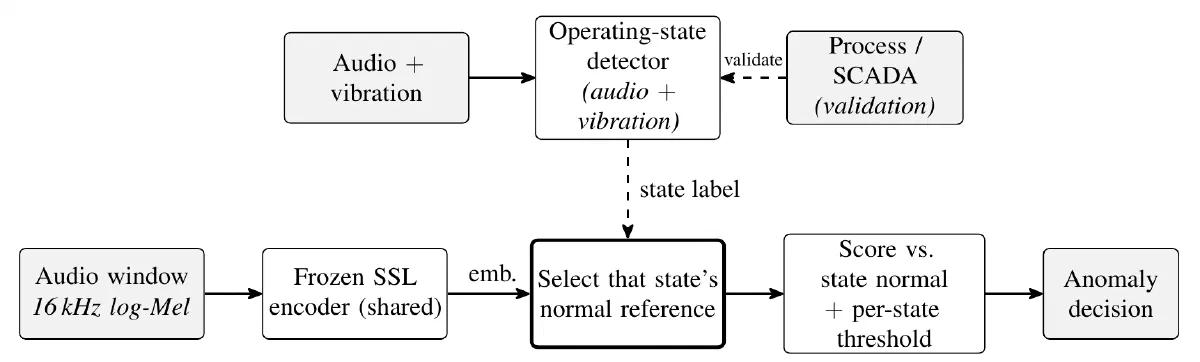
Pumped-storage hydropower plants balance grids with a high share of intermittent renewables, and their condition monitoring rests on fixed alarm thresholds of unknown false-alarm rate. On an acoustic and vibration campaign at one pump-turbine unit, this thesis asks whether self-supervised pre-training on public sound corpora improves anomaly detection when adapted to scarce plant data. The monitor works in two steps. It identifies the operating state from audio and vibration, label-free by clustering or through a model bank fitted once at commissioning. It then scores each window against that state’s normal reference under a per-state conformal threshold, with a finite-sample, distribution-free false-alarm guarantee. The answer is differentiated. A frozen BEATs encoder needs no plant training data and detects 174 of the 180 controlled hammer strikes at a median first-alarm latency below one second, while industrial pre-training recovers the operating-state structure. Adapting either encoder to the plant does not pay, and a distilled 0.78 MB student carries the transient head onto a plant server without a graphics processor. Deployability is decided by the calibration cadence, not the representation. A threshold carried across a change of recording setup loses false-alarm control, reaching a realised rate of 1.00, while daily recalibration is not deployable. Three label-free sentinels decide when that one calibration has expired: the state bank’s own rejection rate fires on every foreign setup, and a watchdog on the monitor’s realised alarm rate catches within-era threshold decay the others cannot see. Together they hold the realised rate between 0.027 and 0.075 on every held-out day at unchanged strike sensitivity. The evidence base is one machine and one labelled campaign, so what transfers is the procedure and its budget, not the constants fitted here.