

Foveated Wi-Fi Sensing: A Mesh That Looks Where It Matters
Your eyes see sharply only where you look, and coarsely everywhere else. Build a Wi-Fi sensing mesh that does the same: it watches the whole room cheaply, and spends its airtime, bandwidth and antennas where someone is moving.
Why this matters
Wi-Fi can sense people: a moving body changes the radio channel between devices, and the new IEEE 802.11bf standard makes this an official Wi-Fi function [1]. But sensing competes with data traffic for the same airtime. Today’s systems spend it evenly, measuring every link of a mesh at the same rate. As a mesh grows, each link is measured more slowly, so the networks best placed to cover a building are the least able to follow a walking person. Vision solved this long ago with foveation: sharp vision in a small region, coarse vision around it, and attention that moves to whatever deserves a closer look.
The idea
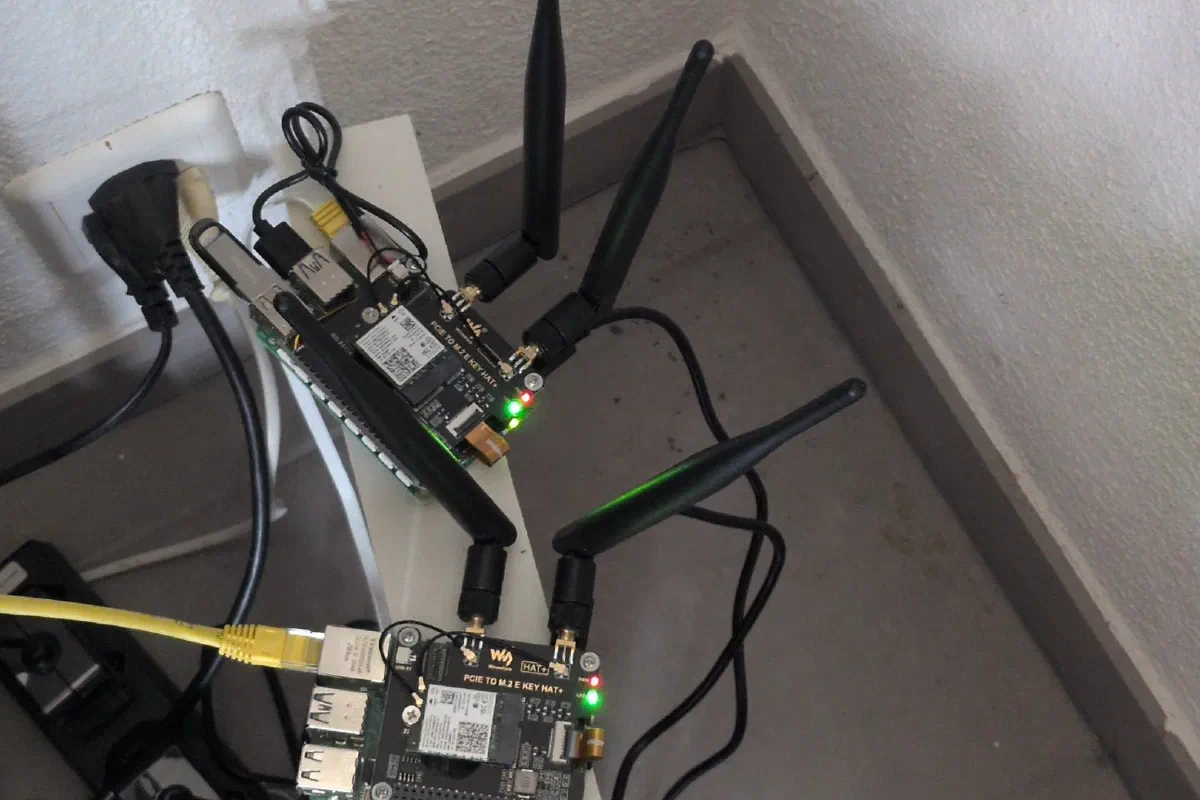
Adaptive sensing is an old idea in radar [2]. A mesh of Raspberry Pi 5 nodes with Intel AX210 cards offers several levers: how often each node measures, how wide a channel it uses, from 20 to 160 MHz, and its two antennas. With the FeitCSI tool, each node can both send measurement frames and record the channel at every bandwidth, also at 6 GHz [3]. The thesis builds a mesh that foveates: a cheap, slow periphery, and a fast, detailed fovea that follows the person.
Research questions
- What each lever buys. How much does measurement rate, channel width and antenna diversity each improve tracking of a moving person, and what does each cost in airtime?
- The control loop. Can a controller that moves the fovea with the person reach the tracking accuracy of uniform sensing at a fraction of its airtime, while a guaranteed floor in the periphery still catches someone new entering? How fast must it react, and when does it oscillate?
- Theory against reality. How well do the coverage map and the feasibility test, both computed from a floor plan before deployment [4], predict what the real mesh can and cannot resolve?
- Attacks on attention. Can an adversary steer the fovea away, for example with a moving decoy or injected frames, to hide a person in the periphery? How can the mesh detect and limit this?
What you will do
- Build the mesh. Set up six or more Raspberry Pi 5 nodes with AX210 cards, building on the capture pipeline already running in our group.
- Measure the levers. Record a person walking along known paths, and measure tracking accuracy against rate, bandwidth and antennas.
- Close the loop. Implement the foveation controller and compare it with uniform sensing at equal airtime.
- Attack it. Test the attention-steering attack and a defence.
Why you will enjoy it
- Hands-on: your own Wi-Fi sensing mesh, with real people moving through it.
- An idea from biology turned into a networked system.
- A running start: the Raspberry Pi and AX210 capture pipeline exists. Background in networking or signal processing helps, and you will learn the rest.
References
[1] IEEE Std 802.11bf-2025. Amendment 4: Enhancements for Wireless LAN Sensing. IEEE, 2025. doi:10.1109/IEEESTD.2025.11184214
[2] S. Haykin. Cognitive Radar: A Way of the Future. IEEE Signal Processing Magazine, 2006. doi:10.1109/MSP.2006.1593335
[3] FeitCSI: CSI extraction and frame injection for Intel AX200 and AX210. github.com/KuskoSoft/FeitCSI
[4] J. Wilson, N. Patwari. Radio Tomographic Imaging with Wireless Networks. IEEE Transactions on Mobile Computing 9(5):621-632, 2010. doi:10.1109/TMC.2009.174
Interested? Email the advisors: Karim Khamaisi, Bruno Rodrigues.