

Language Models as Decoders for Very Slow Wireless Links
A language model knows what a message is likely to say. Put that knowledge in the receiver, and a garbled emergency text that no error-correcting code can repair may still be read correctly. But can we trust what the model reads?
Why this matters
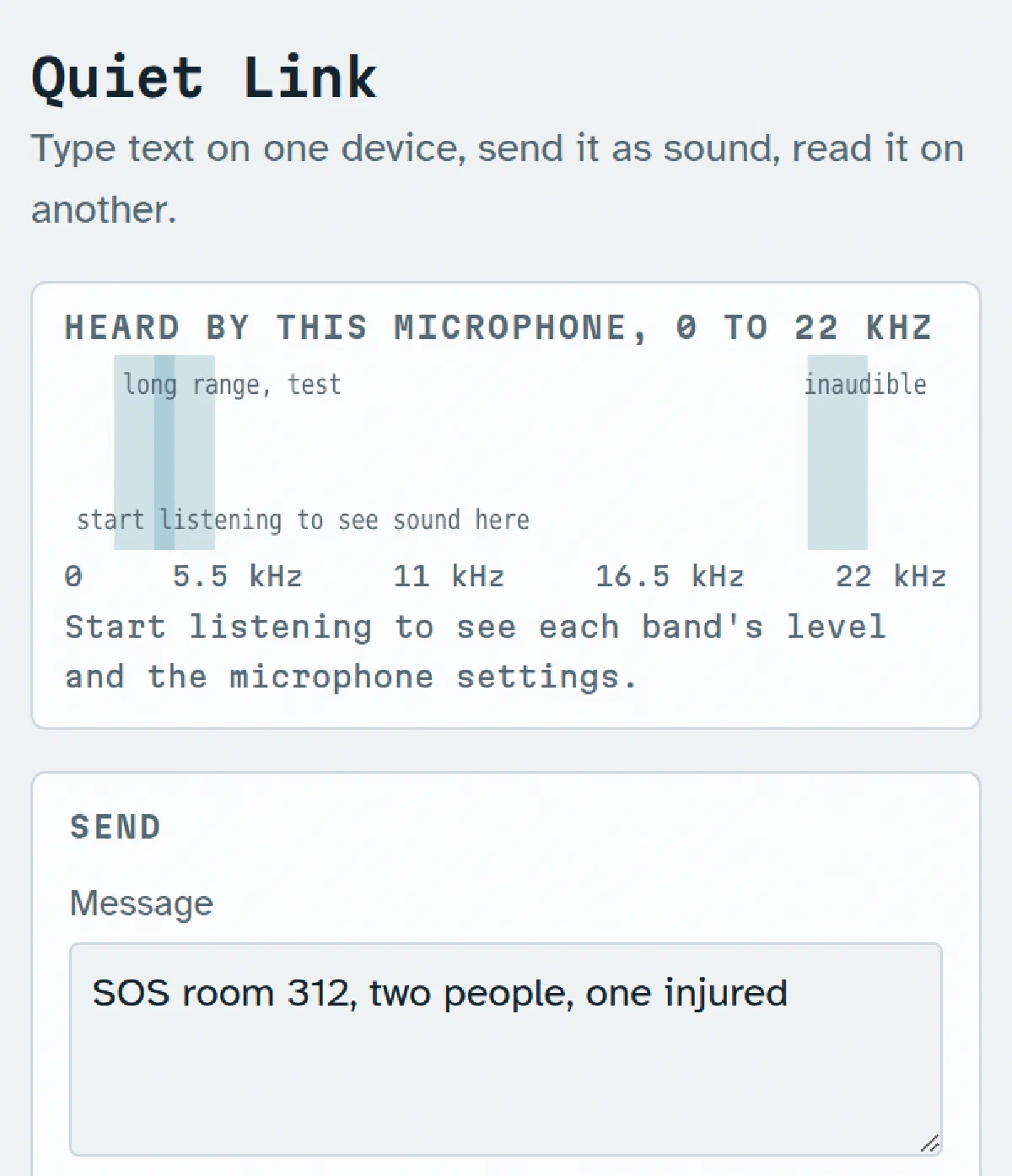
When networks fail, the links that remain are very slow: sound between phones, LoRa radios, satellite SOS. They carry a few dozen bits per second, so every message is short and every bit is precious. Today, the receiver treats a message as random bits. But human messages are not random: “two people trapped, one injured” is far more likely than a random string of letters. A language model captures exactly that knowledge.
The idea
A language model knows which messages are likely. This thesis uses that knowledge when decoding: the receiver keeps several candidate readings of a damaged frame and ranks them by how well each fits the received signal and how plausible it is as a message [1, 2]. A frame that the error-correcting code alone cannot repair may still decode.
Research questions
- The gain. How many decibels does a language prior at the receiver buy on real, slow links, compared with decoding without it? How close does it come to the limit set by how predictable the messages are?
- Real channels. How should the prior work with the soft information of a real decoder, under echoes, noise bursts and a moving sender?
- Trust. A model that “repairs” an SOS into a plausible but wrong message is dangerous. How can the receiver tell a correct repair from a confident invention, and what false-repair rate can it guarantee?
- Offline and embedded. How much of the gain survives when the model shrinks to fit offline devices, from a language model on a laptop, to a small model on a phone, to a character model of a few megabytes on a microcontroller?
What you will do
- Build the decoder. Add language-model list decoding to our Quiet Link receiver, starting with small models that run on a laptop or phone.
- Test on real links. Measure over the air with phones in rooms, and on a second slow link such as LoRa, using a corpus of real disaster messages collected after earthquakes and floods.
- Bound it. Relate the measured gain to the entropy of the messages, which limits how much any prior can help.
- Make it safe. Design and evaluate a confidence test that keeps false repairs rare, even when the model is sure of itself.
- Shrink it. Measure the decoding gain against model size and memory, down to a model that runs offline on an ESP32-class board.
Why you will enjoy it
- Language models meet the physical layer, one of the most active frontiers in communications.
- Real impact: more range for messages when everything else fails.
- A running start: the Quiet Link modem, the over-the-air setup and a corpus of disaster messages exist. Background in either machine learning or communications is enough, and you will learn the other.
References
[1] Z. Li, C. Yue, J. Hao, B. Vucetic, Y. Li. LLM-Viterbi: Semantic-Aware Decoding for Convolutional Codes. arXiv:2604.19035, 2026. arxiv.org/abs/2604.19035
[2] Z. Wang, T. Ren, R. Li, Z. Zhao, H. Zhang. In-Context Source and Channel Coding. arXiv:2601.10267, 2026. arxiv.org/abs/2601.10267
Interested? Email the advisors: Bruno Rodrigues.